

There are few things as awful as the detritus of the 1970s. An era that gave us Crock-Pots, Pintos, Pet Rocks, shag carpet, the avocado green refrigerator and the leisure suit in almost any color at all is an era best lost to history.
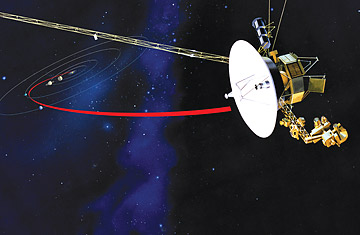
But then there are the Voyager spacecraft. It was in August and September 1977--when Jimmy Carter was in the White House, "Best of My Love" was the No. 1 song, Laverne & Shirley the No. 1 show, and the Dow was headed for a year-end close of 831--that Voyagers 1 and 2 were launched. Their mission was ambitious: fly to Jupiter, then on to Saturn and then, just maybe--if the hardware was working, the gyros were sound and the thrusters hadn't frozen--swing by Uranus and Neptune too. Voyager 2 made that grand tour, flying in the flat straight through the solar system and successfully rendezvousing with Neptune in 1989. Voyager 1 made a gravitational whipsaw around Saturn's giant methane-covered moon Titan, a trajectory that flung it up and out of the solar-system plane and limited it to a two-planet itinerary.
But the ships' primary mission succeeded beyond the giddiest predictions of the engineers who built them. And today, improbably, the mission continues, with the creaky old spacecraft adding 330 million miles to their journey every year--each click of the odometer constituting a new distance record for the reach of the human species. This month, NASA engineers young enough to be the grandsons and granddaughters of the people who built the Voyagers announced that they'd taken new power-saving steps to ensure that the mission continues, and it's not just the distance record they're after. The Voyagers are poised to pass at last from the outermost boundary of the solar system into the truly uncharted regions of interstellar space, and NASA wants them fit for duty when they do.
There's no way of knowing exactly where the solar system ends, but the best guess is that it's up to 12 billion miles from the sun. That's where the last breaths of solar wind--the storm of charged particles the sun continuously pours out--bump up against the tenuous hydrogen and helium that swirl through the cosmos. Twelve billion miles is more than twice the maximum distance from the sun to Pluto (which was still a planet when the Voyagers were launched), so scientists always knew there would be a lot of flying to do before the little ships crossed that distant threshold.
That endgame, however, is approaching. Voyager 1 is about 11 billion miles away; Voyager 2 trails a bit at 9 billion miles. Last December, Voyager 1 beamed back data showing that the charged particles around it appeared to have come to a standstill, suggesting that it had entered a final transition zone before interstellar space. Such an area of stagnation had not been in the astronomers' models, so scientists can't predict how thick the wall will be.
"Our models aren't precise enough to tell us if we'll pass beyond the stagnation zone in the next few days or the next few years," says Voyager project scientist Ed Stone, who is as venerable as the ships themselves, having been with the program since 1972. "But since we travel a billion miles every three years, it should be soon."