

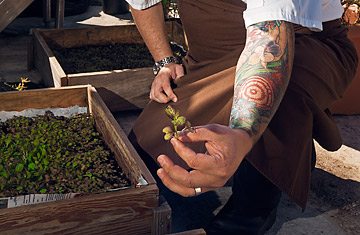
Brock at his rooftop garden in Charleston, S.C.
Sean Brock is listening to a chicken. he's in the prep kitchen of Husk, the Charleston, S.C., phenomenon Bon Appétit recently named the best new restaurant in America. And he is making the crown jewel of Southern cooking--fried chicken--in covered cast-iron pans. He gauges the birds' progress by their muffled sizzling. "They sound happy," he says, in a state of near bliss himself. Everything he is doing is intuitive, atavistic, an act of love and gluttony. This is one side of Sean Brock.
There is another side too, the side that first brought him to light as the most conspicuously gifted American chef of his generation. A few blocks away from Husk sits a grand, four-story manse that is home to McCrady's, where for five years Brock, 33, has been playing the role of molecular gastronomist--a peerless technician whose use of gels, powders and foams seems all the more unexpected given his devotion to lard, grits and other Southern comforts.
When I first wrote about Brock for TIME.com last fall, he was about to open Husk and be inundated with praise, from the Bon App award to an 11-page profile in the New Yorker to a parting declaration by New York Times restaurant critic Sam Sifton that McCrady's is the best restaurant outside New York City. Brock won a 2010 James Beard Award for presiding over the complex dishes at McCrady's, tweezers poised to make sure the ingredients were arranged just so. The fact that he has become even more famous for Husk's pimento cheese and deep-fried pig's ears points to the peculiar dichotomy of our current food choices.
American cooking is at a crossroads. Ambitious young chefs either become locavores obsessed with small farms, offcuts, heritage breeds and a minimum of culinary interference, or they take up the tweezers and dig deep into the arcana of stabilizers and gums, becoming modernist magi. Even for Brock, the chef of the moment, there is no overt attempt to reconcile these philosophies. Both his restaurants have the same sourcing for all their meat, fish, dairy and vegetables, but at first glance, the dishes they produce suggest there is a radical split between the two hemispheres of the chef's brain.
Husk was conceived as a way to celebrate and protect the old ways of Southern cooking. The elixir of rendered pork fat serves as the basis of almost everything served there. It's a paradise of skillet corn bread, raw local oysters with homemade vinegar, brown-butter crumble and red-eye gravy. Contrast those offerings with McCrady's twist on shrimp and grits, a classic low-country dish. The grits come from a locally grown and nearly extinct strain of corn called Jimmy Red, which is hand-shelled, flash-frozen with liquid nitrogen and cold-milled. The shrimp are dehydrated and pulverized so they won't overpower the grits, and the virtuoso technique is as much a tribute as it is reinvention. If Husk is all about down-home dedication, then McCrady's is a crucible of high ideals and hardcore attitude. I call this style of cooking lardcore. It's meticulous, it's ballsy, and it doesn't care what you think of it. In that, it's very Southern.