

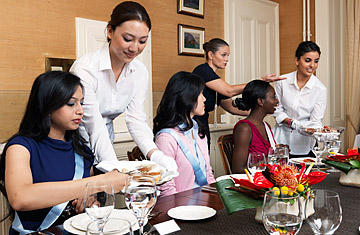
Students learning dinning, serving and other customs at Switzerland's Institut Villa Pierrefeu, which costs about $20,000 for a six-week course.
(2 of 3)
It's this reality that draws midcareer executives to enroll at IVP, where they hope to gain an edge with international clients; younger students come to prepare for careers in public relations and the foreign service. Princesses and the daughters of Presidents and Prime Ministers enroll to better perform such duties as entertaining dignitaries and giving gifts while abroad. During TIME's recent visit, the school's roster listed 36 women, ranging in age from 18 to 46 and hailing from 14 countries including Syria, Thailand and the U.S. Given their high-profile backgrounds, the students don't share their last names with teachers or with one another. And their refinement comes at a price: a six-week course, which includes room, two daily meals and weekend excursions, costs about $20,000. Married students, including a Supreme Court judge from a European country who recently studied at IVP, often elect to stay in nearby hotels with their families and nannies.
Dropping Courses like Sewing
Perched on the hills overlooking Lake Geneva, Nri's school is set in and around the former home of a Dutch baroness, built in 1911 as the Belle Epoque drew to a close. Nri's mother acquired the property and established the school in 1954. "She wanted a house that would correspond to the type of house the students would have and entertain in," she says. "The kitchen is downstairs because it assumes you have servants." The ground-floor layout assumes students also have six chandeliers, 16 paintings and a marble staircase.
By the time Nri took the helm in 1972, many of her traditional rivals--the more than 60 finishing schools established around Lake Geneva before World War I--had shut down or fallen into decline. In some instances, it was an issue of succession: the founders' emancipated daughters simply didn't want to take the reins. In other cases, schools sitting on prime real estate were sold to the highest bidder. Subsequent decades saw the closure of iconic schools like Mon Fertile, which refined Camilla Parker Bowles, and the Institut Alpin Videmanette, which counted Princess Diana among its alumni. Le Manoir now serves as the headquarters of Tetra-Pak, a food-processing company, and Le Matin Calme was transformed into a private residence that has passed through several owners, including Shania Twain.
But IVP has managed not only to stay open but also to keep filling up months in advance. Nri and her staff members--who frequently visit the Middle East to tutor royalty in the comfort of their palaces--may be as good at strategic planning as they are at party planning. As early as the 1970s, Nri began courting students from Latin America and Asia who slowly replaced gap-year students from Britain and Germany. Nri dropped courses like sewing and expanded the curriculum to reflect the changing demographics of global influence and power. She started teaching classes in English instead of French and eventually broadened courses to cover the customs of each of the BRICs--Brazil, Russia, India and China--the emerging markets where women are increasingly likely to conduct business. "This was never the kind of school where you just walked around with books on your head," she says. "We've always targeted the career woman."