

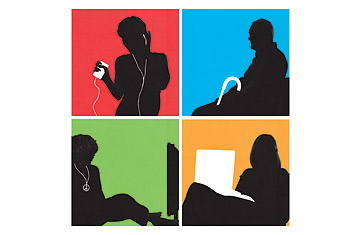
The generation gap
Alexandra Serna cast the first presidential vote of her life in 2008, for Barack Obama, with enthusiasm and hope. Three years later, the 24-year-old, earning a degree in accounting at Florida Atlantic University (FAU), still supports the President. But her optimism has faded. "I think he's trying really hard," Serna says in a study room on the school's Boca Raton campus. Yet she's anxious about finding work after she gets her degree, and when asked whether she's politically engaged nowadays, she replies, "Personally, I'm not." While Serna isn't about to vote Republican in 2012, she hardly seems a sure bet to turn out for Obama.
Eating lunch in the food court of a sleepy shopping center 10 miles from the FAU campus, 78-year-old Walter Levy has few kind words for the President. The Navy veteran, who voted for John McCain in 2008, grouses about the state of the country and its government. "We're going backward right now," says the Fort Lauderdale resident. "The government's gotten itself too involved in everybody's life." His wife Concetta, 77, is more blunt. "I don't like the President's policies," she says. "I don't like Solyndra." The Levys are primed to vote Republican next year.
Listen to these three closely and you can hear the two Americas speaking. For the past several years, our political conversation has focused on great divides in our national life: red and blue, the coasts vs. the heartland, the 1% vs. the 99%. But the deepest split is the one that cuts across all these and turns not on income or geography but on age. In the past few national elections, young and old Americans have diverged more in their voting than at any other time since the end of the Vietnam War, according to the findings of an extensive new Pew Research Center poll. The survey reveals that the youngest and oldest voters have strikingly different views on everything from the role of government to the impact of the Internet and suggests that the 2012 election could be one of the starkest intergenerational showdowns in American history, not just in Florida but coast to coast. Different generations rarely vote in lockstep; each is shaped by different formative influences. But this is something unusual. "We've got the largest generation gap in voting since 1972," says Andrew Kohut, president of the Pew Research Center. "Since 2004 we've seen younger people voting much more Democratic than average and older people much more Republican than average. And that may well play out again in 2012." Indeed, Pew's Generational Politics poll shows a yawning generation gap in a hypothetical matchup between Obama and Republican Mitt Romney. Voters 30 or younger favor Obama 61% to 37%. Seniors over 65 choose Romney 54% to 41%. With Americans born from 1946 to 1980 (baby boomers and Gen Xers) almost evenly divided, the youngest and oldest voters stand in even starker contrast.
iPhones vs. IRAs