

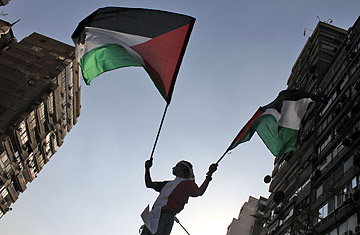
As world leaders gathered in New York City in mid-September for the annual talkfest that is the U.N. General Assembly, the hottest topic of conversation was a Palestinian proposal to apply for statehood. The Palestinians say this is their best hope of restarting stalled peace talks, but Israel has denounced the plan, arguing it compromises chances of direct negotiations. The Obama Administration has vowed to veto any resolution brought to the Security Council, but a vote in the General Assembly could give the Palestinians a symbolic victory: recognition as a nonmember observer state, similar to the Vatican. How would any outcome affect the possibility of peace between Israel and the Palestinians? TIME asked four respected commentators to weigh in.
Why Israel Should Vote Yes
By Yossi Beilin
It's being called a lot of things, the Palestinian bid for recognition as a state at the U.N., but in Israel the metaphor of choice is "train wreck." Israelis have been bracing for September for many months, ever since Mahmoud Abbas, the President of the Palestinian National Authority, began hinting that without meaningful negotiations aimed at a two-state solution, the path forward ran to New York.
As the momentum has mounted, Israel and its stalwart ally the U.S. have fumbled for a way to divert the Palestinian express. President Obama promised to veto any application for full membership in the Security Council and to lobby against any meaningful alternative status in the General Assembly. Members of the U.S. Congress threatened to punish the Palestinian Authority by severing $550 million in aid, and ministers in Prime Minister Benjamin Netanyahu's coalition threatened to withhold the vital tax receipts Israel collects for the Palestinians. Others, also trying to be helpful, suggested a dramatic last-minute resumption of talks.
But one way to prevent a train wreck is to climb on board. Israel should announce its support for a state of Palestine.
Such an announcement would do what Netanyahu promised during the previous round of talks more than a year ago: "Surprise the world." Support for a state of Palestine would ring the same major chords as the 1979 peace treaty with Egypt or the surprise announcement of the Oslo accords, which I initiated. In a Middle East where the Arab Spring has made dignity a core value, it would also show respect. And, with the proper care, it would make immense sense for Israel itself.
The U.N. is not where this conflict began, but it is where it was first made the world's business — internationalized, in the language of the day — and it is the place it can begin to be laid to its final rest. In 1947, the newly formed General Assembly voted to partition the disputed lands into two states: one Jewish, the other Arab. The Jews accepted, and Israel was admitted to the U.N. Now that the Palestinians are poised to accept as well, it's only sensible to accept them.
Great care must be taken in the terms of the statehood resolution. The point of climbing aboard the train, after all, is to help steer or at least point out hazards on the track ahead. The one area of agreement between Palestinian and Israeli leaders is that the essential issues can be settled only by negotiation. So the measure put before the U.N. should be designed to keep moving the peace process that Israel's announcement will have brought back to life.
The core issues are well worn from years of handling: Palestine's borders can be fixed only by agreement with Israel, and the basis of all negotiations for the past 20 years has been the lines on the map in June 1967, at the start of the Six-Day War. In Jerusalem, there would be two recognized capitals: one for Israel and one for the Palestinians. The security arrangements for both sides would be guaranteed and the problem of Palestinian refugees resolved, essentially, in the new Palestinian state.
In fact, the elements of a U.N. resolution already exist in the second stage of the 2002 U.S. plan known as the road map to peace, which calls for a Palestinian state with provisional borders while negotiations proceed on a permanent-status agreement — and an Israeli freeze on construction in the settlements. Once the boundaries of the Palestinian state are agreed on, Israel will be free to build whatever it likes on its side while the matter of its full recognition of Palestine proceeds to the Security Council. There should be no worries about a veto there if the interlocutor through all of this is, as it should be, the U.S. History is calling. Surprises do not have to be unpleasant.
Beilin, a former Israeli minister, now heads a business consultancy