

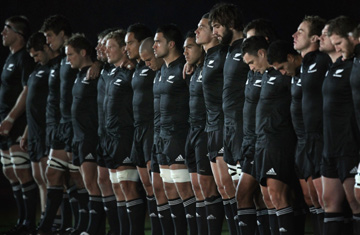
Facing down a challenge New Zealand's All Blacks line up against Scotland in Edinburgh on Nov. 13, 2010. A World Cup win would buoy the rugby-crazy country after February's earthquake
Corey Flynn had just finished training with his teammates at the Rugby Park ground in suburban Christchurch when, around lunchtime on Feb. 22, the ground began to shake. Once the tremors had subsided, the New Zealand rugby star was struck by an odd silence. "And then we heard the car and house alarms and the sirens and knew that something had gone down," he recalls. What Flynn, his fellow players in the local Canterbury Crusaders rugby team and the rest of the residents of Christchurch discovered in the following hours and days was that a massive earthquake had ruined thousands of homes, torn down the city's 19th century cathedral spire, toppled buildings, including a local television headquarters, and killed 181 people.
Then, 22 days later, came an aftershock: with the city's rugby stadium damaged and the tourism infrastructure depleted, the New Zealand government announced that the seven games of the 2011 Rugby World Cup that were scheduled to take place in Christchurch would be moved to other venues. To a city obsessed with the sport, the announcement felt like a kick when Christchurch was already down.
"It's hugely disappointing that we couldn't bring the party here," says Flynn, who is in the New Zealand squad of players named for the finals, which begin on Sept. 9 and whose winners will boast of being the best in the world for the next four years. The ultimate salve to the city's, and the country's, wounds would be for Flynn and his fellow All Blacks, as the New Zealand team is known, to lift the Cup after the final game on Oct. 23.
Rugby may seem like a violent game played by oversize bruisers, but the Rugby World Cup has a history of healing wounds as well as battering bodies. In 1995, a year after elections marked an end of the apartheid era in South Africa, the country's rugby team, long viewed as a symbol of the minority white governments that ruled the country for 46 years, won the Cup in South Africa. For a nation of two peoples still figuring out how to be one, the sight of the new President, Nelson Mandela, wearing the green-and-gold team shirt and presenting the Cup to the white captain of the South African team was a powerful act of reconciliation. The stirring tale would be turned into an award-winning 2009 film, Invictus, which would inspire global audiences that knew nothing about the sport.
The stakes for New Zealand at this World Cup may not be as high, but a win would ease the pain of a city and country still rebuilding and mourning. Much of Christchurch is still in ruins. Metal fences keep the public out of large sections of the downtown area. Thousands of people are still in temporary housing. "The earthquake did hit people hard, so we need some good spirit in the city," says Evan Smith, a business-support analyst whose house was destroyed in the quake.
With a population of just over 4 million, New Zealand usually plays only a bit part on the world stage. It contributes a small number of soldiers to the NATO-led forces in Afghanistan, has a highly developed economy, and its stunning natural beauty was introduced to millions as the backdrop to the three Lord of the Rings movies. But in the world of rugby, New Zealand is a giant: it routinely beats teams from bigger nations like England, France and (most satisfying for New Zealanders) neighboring Australia. The All Blacks are to rugby what Brazil is to soccer.
Except for one hitch: New Zealand has not actually won the World Cup since it hosted the inaugural tournament in 1987. Now, more than ever, the All Blacks need to rectify that glitch in their record. "The All Blacks winning or losing usually seems like a matter of life and death to most New Zealanders," says Richard Swain, director of operations at University of Auckland's Faculty of Medical and Health Sciences. "But I think we'll all be watching the team now as an affirmation of life, resiliency and pride of a nation that's really been through a lot."
The All Blacks' repeated failure to win the Cup has become something of a national embarrassment. "People talk about monkeys being on the back, but this is King Kong," says Steve Tew, the chief executive of the New Zealand Rugby Union, the body that oversees the game in New Zealand.
South Africa and Australia have each won the tournament twice; England, once. But no country has quite the passion of New Zealand. That attachment is in part a relic of the colonial past that brought Britain — and, with it, rugby — to the southern hemisphere. Long a game of the English snooty classes and the public schools they attended, rugby became a settlers' sport. As soccer grew into the dominant sport in Europe over the past century, "rugby became increasingly ingrained in the social and cultural fabric of many southern-hemisphere nations," says Welsh sports historian Gwyn Prescott, whose book This Rugby Spellbound People, about 19th century Welsh rugby, is set to be published this year.
That's not to say the Europeans will be pushovers. Jérôme Thion, who played on the 2007 France team that stunned New Zealand in the quarterfinals of the past World Cup, says the north is yearning for what would be only its second-ever win. "Of course, on game day — especially in the World Cup — the excitement, dedication and desire to win is identical everywhere," he says. But there's no denying that the All Blacks, playing not just for sporting glory but to lift a shaken nation, will start as the sentimental favorites.
— With reporting by Bruce Crumley / Paris and Cassandra Murnieks / Christchurch