

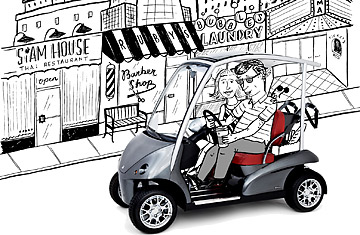
Central park South in Manhattan is everything that is awful about driving in New York City. Tour buses, horse-drawn carriages, trucks, cyclists, taxis and passenger cars converge from Fifth Avenue in a tortured tango of man and metal trying, without apparent success, to get somewhere in a New York minute. And now I am adding another machine to the transportation mix: a battery-powered Garia LSV, which is short for low-speed vehicle.
Garia is the latest entry in the market for LSVs, which are essentially street-legal golf carts. They used to be confined to retirement villages and gated communities, where no one is in a particular hurry and traffic is a sign of vitality. But changes in state laws have made these souped-up golf carts increasingly popular on regular roads, and some towns have been accommodating the surge by doing things like converting parking spaces for these itty-bitty buggies and designating which major intersections they can cross.
According to the Insurance Institute for Highway Safety (IIHS), most states now allow LSVs on any road where the speed limit is 35 m.p.h. or less. This makes LSVs legal in New York City, where the crush turning onto Central Park South reveals some advantages the Garia has over a typical sedan. The Garia is made by a Danish company of the same name that has positioned itself as the Porsche of the LSV market. (Its vehicles are made in Finland at the same factory that assembles the Porsche Boxster.) The tricked-out $21,000 model I am testing has a dashboard refrigerator and chrome wheels. But by federal decree, it can't go any faster than a very un-Porsche-like 25 m.p.h. Its squat front end means I can weave through the swarms of pedestrians more easily, and the turning ratio is such that cutting into traffic is a snap.
But then comes the reality of what this maneuverability means: Do we really want LSVs, which have little in the way of passenger protection, out there with the heavy metal? When the IIHS crash-tested one popular LSV model, the GEM e2, the results weren't pretty. In one test, the institute took the smallest car on the market, the Smart, and rammed it into a GEM at 31 m.p.h. Sensors showed that the crash-test dummy in the Smart was protected from serious harm by the car's air bags and roll cage. The GEM dummy was toast. David Zuby, chief research officer of IIHS, called LSVs the undoing of 40 years of auto-safety improvements. To be street legal, LSVs need headlights and taillights, rear and side mirrors and seat belts, but they don't have to pass the crash tests required of all passenger cars and trucks, nor do they have side-door air bags. Heck, they don't even have side doors.
The relatively low price of LSVs--the cheapest sell for about $7,000--make them affordable to more people. But when a colleague took a look at the Garia, she said there's no way she'd drive it in Manhattan. This did not prevent her from assigning me to drive it. Having done so, I'd have to agree with her assessment. These are still golf carts, and they have their place. But not in the big city.