

(2 of 3)
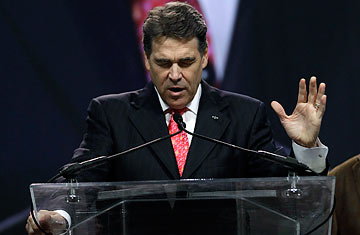
"Rick Perry is going to be the superhero action figure for the Tea Party and social conservatives," says Republican strategist Mark McKinnon.
Also, Perry would become the only sitting governor in the race and has the executive credentials Bachmann lacks. In his 10 years as governor, he has virtually taken over the state's sprawling government, installing allies on every board and commission and pressing an aggressive legislative agenda of budget cuts, tort reform and limited regulation. It is this classic Republican formula that Perry hopes to transplant to Washington. "Government," he says, "needs to get out of the way." Which means that he aims to combine Romney's street cred as an executive with Bachmann's stripes as a rebel.
But lurking behind Perry's record of job creation are substantial caveats. Perry largely inherited from George W. Bush the state's business-friendly environment, with no income tax, an abundant energy supply and a steady influx of cheap labor. And the state is hardly a workers' paradise. Nationally, Texas ranks at the bottom in terms of health-insurance coverage; many of the jobs he has created are low-wage positions, and many of the jobs he has lured from other states have required public money and tax subsidies. Moreover, Perry has made fiscal missteps. He had to scramble to close a $27 billion budget shortfall earlier this year. A superhighway he proposed was killed after howls of protests statewide, and he created a public-private business-development fund that has opened him up to charges of cronyism. Meanwhile, he has a record of sticking his nicely hand-tooled boot in his mouth. His most unpresidential remark came in 2009 at a Tea Party rally in Austin, when Perry was asked whether Texas might secede from the Union if Washington couldn't get its act together. "There's a lot of different scenarios," Perry said. "We've got a great Union. There's absolutely no reason to dissolve it. But if Washington continues to thumb their nose at the American people, you know, who knows what might come out of that?" An off-the-cuff remark, perhaps. But even a vague threat to break up the United States of America is a tricky — perhaps impossible — thing to explain away at a presidential debate.
Too Much like Someone Else?
Perry is a fifth-generation texan, which means his ancestors arrived about the same time Texas went from being an independent country to a state in 1845. With his prickly mistrust of East Coast elites, he still displays the marks of someone from the tiny West Texas crossroads of Paint Creek, where his parents worked long hours to make a living as cotton farmers. "For me," Perry says, "the essence of being a Texan is, these are people who can sustain through hard times but they're people who always think that better days are ahead."
Perry's entire career has been unconventional, propelled by a keen sense of timing and a prairie cyclone of good luck. After graduating from Texas A&M and flying C-130 cargo planes in the Air Force, he found his way into politics, becoming a fast-rising Democratic state legislator in 1985 and even chairing Al Gore's 1988 primary campaign in Texas. "I was 25 years old before I think I ever met a person who would admit to being a Republican," he says now. Like others of his generation, Perry switched parties just as Republicans solidified their hold on the Lone Star State. In part with the help of a young strategist named Karl Rove, he defeated a popular incumbent to become Texas' agriculture commissioner, then ran for lieutenant governor in 1998.
After succeeding Bush as governor in 2001, Perry was sometimes teased as a lucky stiff who blundered into one of the best jobs in politics. But he then won two consecutive re-elections, including a 2010 primary fight in which he smacked back a challenge from the state's popular senior Senator, Kay Bailey Hutchison. Though he has been a more partisan governor than Bush, Perry is sure to remind many of the previous President — the stylized accent, the cocky self-assurance, the ever present cowboy boots. Perry says that when he called Bush with birthday greetings in July, the former President told him, "You don't want to wake up when you're 70 and go, 'I wish I had tried that, I wish I had done that.'" Still, the relationship is a complicated one. While the two men maintain a public amity, bad blood runs between the Bush and Perry camps. Many of Bush's former advisers openly disdain Perry, in part because Perry once questioned Bush's fiscal-conservative credentials.