

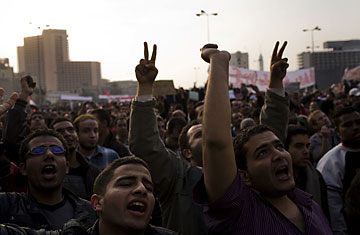
Protests in Cairo's Tahrir Square in February
When I talk to people in Egypt, I still hear a lot of optimism about the revolution — and plenty of concern that progress isn't coming soon enough. People want good democracy yesterday, and they want a good lifestyle by tomorrow. But that's not going to happen because the economy just isn't there yet. It's really been crippled by the revolution. Tourism has dried up, and investors don't want to put in capital when they don't know where the country is going.
When we talk about the Arab Spring, we talk about democracy, about nations rising up to demand representation from their leaders. But it's important to remember that the movement began with a young man's losing his livelihood. On Dec. 17, Mohammed Bouazizi, a 26-year-old street vendor in Tunisia, set himself on fire shortly after an inspector stopped him from using his unlicensed produce cart, the only means he had to feed his family. A month after Bouazizi's final act inspired so many young people to protest, the President stepped down. The revolutionary tide had begun. But jobs were the impetus, and they will be crucially important in paving the way for stability in the Middle East and North Africa.
And that's why groups like ours are focusing on the two things that motivated the youth of the Arab revolution: unemployment and a determination to change their society. In some of these countries, more than 25% of young adults are unemployed, and even those with college degrees often lack the skills employers need. Job training — and job placement — is either bad or nonexistent. That's why I created the Education for Employment Foundation (EFE), a network of locally run nonprofits that not only prepares young adults for the workforce but also commits companies to hiring them. Our premise: when young people have satisfying jobs and the hope of building a future, they help lay the foundation for peaceful societies.
So while democracy efforts may be faltering in some places, we shouldn't give up hope, because there are many pathways to progress. EFE measures success with each new hire, watching our graduates start to take care of their basic needs as well as assume more responsibility as citizens. One EFE alum, Haifa al-Maqtari, is a 24-year-old in Yemen who earned a bachelor's degree in English literature but couldn't find a job. Through EFE, she is now supporting her family as an administrative assistant and is volunteering in a program that offers vocational training to young people in the hot zones surrounding Sana'a that have seen tribal and sectarian conflict. This, by the way, is the same Yemeni who two years ago thought "unemployment was the fate of every person," she says, "a dark cage that would not let anyone escape."
We have seen the impact of vocational training and job placement ripple not just through Yemen but also through Egypt, Jordan, Morocco, the West Bank and Gaza, where collectively we administered 42 training programs last year and graduated 1,118 students. This year we expect to train and graduate 3,000 and to increase civic engagement through jobs and the self-empowerment that comes with them.
Waleed Haroun is a great example of this. We placed him in a job at a bank in Egypt, where, after participating in the protests in Tahrir Square, he organized neighborhood efforts to get people to stop littering and to start waiting in line rather than pushing their way onto buses and metros. "For the first time, we feel that this land is ours," says Marwa Rushdy, EFE's alumni coordinator in Cairo. "So we should be doing something to make our country the best." And that's what makes such seemingly small things, like one job at a bank and a little less trash on the streets, so revolutionary.
TIME 100
The second in a series of essays by TIME's most influential people in the world