

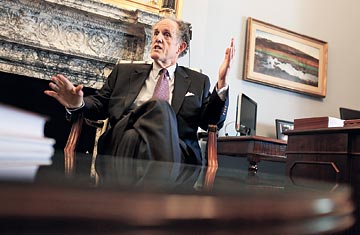
Ted Kaufman (D-Del.) was appointed to fill Vice President Joe Biden's former senate seat after the general election in November
As the lamest of the Senate's lame ducks, Delaware Senator Ted Kaufman should be coasting at this point. No matter what happens in November, he will be out of a job a few days later, when his two-year turn as Vice President Joe Biden's appointed replacement comes to an end. "I'm junior," the wild-haired, 71-year-old former Biden staffer admits. "I can't get more junior."
But instead of sailing quietly into oblivion, Kaufman has decided to make waves. Most notably, he is challenging his Senate colleagues--and the Obama Administration--to get behind far tougher financial regulations than they have yet proposed, a move that has been unsettling to both bank lobbyists and White House aides. "I think most people know that I am really cranked up about this," Kaufman says with a smile.
In late March, after most of his colleagues had split for the Easter holiday, Kaufman lingered on the Senate floor, waiting for his chance to address rows of empty chairs, a few pimple-faced pages and the C-SPAN cameras in his latest well-sourced broadside against the conventional wisdom on Wall Street and in the White House. "Unless Congress breaks up the megabanks that are 'too big to fail,'" he declared to an empty chamber, "the American taxpayer will remain the ultimate guarantor in an almost-certain-to-repeat-itself cycle of boom, bust and bailout."
As a policy matter, Kaufman's prediction is heavily debated among economists. But as politics, his critique threatens to undermine the White House's finely tuned election-year story line. To hear President Obama or his aides tell it, the coming Senate debate on financial regulatory reform will offer a clear choice to voters this fall between most Democrats who are defending the interests of Main Street and most Republicans who are in the pocket of Wall Street. Kaufman, by contrast, argues that neither party has yet shown much seriousness about undoing decades of deregulation, and nonregulation, that created the conditions for the financial collapse in the first place.
"Little in these reforms is really new," Kaufman says of the current White House--backed Democratic Banking Committee plan. He calls the provisions for new "resolution authority" to dissolve failing banks "an illusion," since the sheer size of the institutions makes painless, prepackaged liquidation unlikely. He worries about loopholes that exempt certain highly profitable derivatives from federal oversight. But most of all, he believes the current Senate plan, which relies on the wisdom of bank regulators, won't prevent another crisis. "The sad reality is that regulators had substantial powers," he announced during another Senate-floor speech in March, "but chose to abdicate their responsibilities."
The White House has mostly avoided direct public engagement with its unlikely critic. On ABC's This Week recently, White House economic aide Larry Summers dodged a question about Kaufman's complaints. "Senator Kaufman is exactly right," he said instead, sympathizing with the concern about large bank failures. In fact, on whether to dismantle the largest banks, it would be hard for the two men to disagree more.