

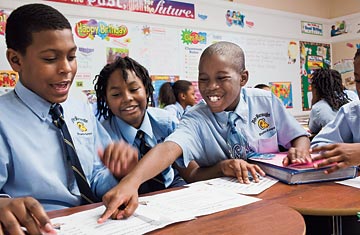
From left: Rodney Thomas, Tyreke Johnson and Malik Harris, at Burroughs Education Center in Washington, look at their payment vouchers
(3 of 9)
At Harvard, fryer heard about a school in New York City that was trying to incentivize kids on a small scale. The idea appealed to him because, unlike reforms focused on the teacher or the curriculum, it treated kids not as inanimate objects but as human beings who behave in interesting ways. But he had no idea if it would work.
In 2005 he persuaded Gavin Samms, a friend and Harvard colleague, to go to New York City with him to try to sign up some schools for a pilot program. "We didn't know anything about what we were doing," Fryer says. They couldn't afford to stay in New York, so they stayed at a hotel in the Meadowlands--a grim tract of wetlands in New Jersey. Then they drove around to pitch the idea to principals.
One day while they were visiting a school, they got a call from the school system's headquarters, which had originally approved their project. "They said, 'You gotta leave now,'" Samms remembers. "'You gotta leave the schools.'" Fryer protested, but he lost. "It was just too political," he says. "It was an election year. They'd already gotten letters saying, 'You can't be paying kids.'"
New York City schools chancellor Joel Klein doesn't remember kicking Fryer out, but he concedes that the program was contentious. "When people want to try new and different things in education," Klein says, "it will always stir up controversy."
In January 2007, after the mayoral election had come and gone, Fryer returned to New York--this time with a more audacious plan. He wanted to create a treatment group and a control group, just like a real scientist. And he had a $2 million grant from the Broad Foundation, which had taken an interest in Fryer because of the scientific rigor of his approach.
This time, Fryer wanted to get a random sample of city schools to participate. Which is not as easy as it sounds. At some schools, the principal and teachers opened their arms wide and said, "Sure. We're struggling here. We'll try anything." At others, Fryer had to spend hours pleading with staff who felt kids should learn for the love of learning--not for the cash. "To this day, I can't tell you what will predict one or the other," he says. "I could walk into a completely failing school, with crack vials on the ground outside, and say, 'Hey, I went to a school like this, and I want to help.' And people would just browbeat me about 'the love of learning,' and I would be like, 'But I just stepped on crack vials out there! There are fights in the hallways! We're beyond that.'"
Eventually, Fryer and his team got 143 schools to sign up. About half would be randomly selected as a control group, meaning the kids would not be paid. In the other half, students would earn money for their performance on 10 routine tests given throughout the year.
The summer before the experiment began, a New York Daily News reporter heard about the plan. The story, headlined "It's a Cash Course," quoted an antitesting activist who called the plan "horrendous." One of Fryer's other funders pulled half a million dollars. Fryer got kicked out of the schools again, he says. This time, Klein took him to a Yankees game. A few days later, Fryer was allowed back in the schools. But he started waking up at 3 a.m. to check the newspapers.