

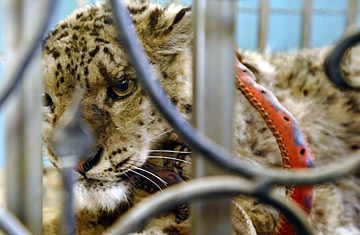
The snow leopard that was caught by a hunter in Afghanistan and rescued by NATO troops
In a valley high in the Wakhan Mountains of Afghanistan several weeks ago, a hunter waded through snowdrifts to check his traps and found that he had snared one of the rarest creatures alive: a snow leopard. If a naturalist had seen the leopard, he or she would have focused on its snowy fur with black, half-moon markings and its white goatee. A naturalist would have known that it is a solitary night hunter that roams the icy Central Asian peaks far above human villages. A naturalist also would have known that there are only an estimated 3,500 to 7,000 snow leopards left on the planet. But the hunter who snared the snow leopard saw only a $50,000 price tag, the fee supposedly offered to anyone who can deliver one--alive.
With the help of a few friends, the hunter tied the leopard's legs and muzzle, threw it in the back of a truck and headed out of the Wakhan Valley to Feyzabad--a three-day journey along terrifying mountain roads. But the capture of a snow leopard, once believed to be extinct in Afghanistan, could not stay secret for long. The feline became the object of a four-day international rescue operation that would end like so many other efforts with similarly good intentions in Afghanistan.
The hunter and his friends were undone by their own greed. Upon reaching Feyzabad, they thought they might get a better price for their cat than $50,000 and began to shop around. "Somebody on the Internet was supposedly offering $2 million for a live snow leopard," says Mostapha Zaher, director general of the National Environmental Protection Agency in Kabul. "I raised a hullabaloo." He paged through his contacts book, eventually reaching the Afghan President. It had been a hard day for Hamid Karzai; suicide bombers and gunmen had attacked an Indian guesthouse in Kabul, killing dozens. But the President was sympathetic to the animal's plight. "He told me, 'Do what you can to save him,' " says Zaher.
The leopard was confiscated from the hunters, and Richard Fite, a New Hampshire veterinarian who in an adviser for the U.S. Agricultural Department in northern Afghanistan, was dispatched to tend to the large cat. Fite was more accustomed to dealing with farm animals. To encounter a snow leopard was a marvel. "I never imagined in my life that I would be so close to such a creature," he says. When Fite examined the leopard, its cage was littered with chunks of uneaten raw meat. When he looked into the animal's eyes, he could tell it was ailing.
Over the next three days, he tended to the leopard. Then, after he got advice from experts at the Wildlife Conservation Society in Kabul, a decision was made to fly the leopard back to the Wakhan and free it into the wild once it had regained strength. "We didn't want it dumped unconscious on a snowfield where it would freeze to death," says Dave Lawson, the society's country director in Afghanistan. Bad weather kept a U.S. helicopter grounded. After what seemed like a day of improved health--the leopard was holding its head up and grooming itself--and a break in storm clouds that would allow the chopper to take off, Fite was optimistic. But the next morning, on March 2, he was informed that the animal had died. "My guess--and it is just that--is that it died from shock," he says.