

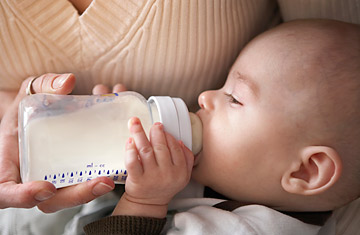
Crystal Byrd tried breast-feeding her first child but stopped after nine weeks. "I just did not like it," says Byrd, 33, a stay-at-home mom in Cedar Creek Lake, Texas. "I'm a huge fan of breast milk, just not of nursing." That's why her plan for baby No. 2 was to pump her milk and bottle-feed it.
Despite warnings from doctors and lactation consultants--who said she would not produce enough milk this way and might not bond with her baby--Byrd managed to feed her second-born exclusively with expressed breast milk for four months. During this period, in 2003, she also stashed enough milk in a freezer (she estimates she pumped an extra 3,500 oz., or 103 L) to last until the baby's first birthday. After her third child was born, in 2009, she pumped for 8½ months.
Byrd is one of thousands of moms who have adopted a feeding system referred to as exclusively pumping (EP) and joined community groups on sites like BabyCenter and iVillage to discuss it. Their reasons for not putting baby to breast vary. Some women have inverted nipples or infants who are unable to latch on. Other moms say they dislike the feeling of a suckling baby or are uncomfortable with the possibility of having to breast-feed in public.
For Byrd, a key issue is time. She says it takes her half as long to pump and bottle-feed as it would to breast-feed. Why? Because she can express milk from both breasts at the same time rather than waiting for her baby to switch from one side to the other.
Technology has helped fuel the EP trend. Medela, the Swiss breast-pump maker and industry leader, has improved the way its portable electric pumps mimic a baby's suckling to stimulate the flow of milk. Another company, PumpEase, makes a hands-free pumping bra that lets busy mothers pump while checking e-mail or even holding (if not feeding) their baby.
But this circuitous delivery system may lessen some of the benefits of breast milk. Studies have found, for instance, that breast-fed babies are better able than bottle-fed infants to determine when they're full. And this appears to help breast-fed children develop healthier eating behaviors, reducing their risk of obesity down the road.
There's also an evolutionary angle to consider. Given that alternatives to breast-feeding did not exist for 99.9% of human history, Gordon Gallup, a biopsychology professor at the State University of New York at Albany, suggests in the January issue of Medical Hypotheses that the likeliest reason a mother of yore would not have breast-fed was the death of her child. He theorizes that bottle-feeding on some level simulates child loss and could increase the risk of postpartum depression. Pumping may protect against this, but for some women may not stimulate milk production as well as a suckling infant does.
Yet for many new mothers, pumping is the only way they say they can be certain they're providing enough milk. "Some of us moms are a little neurotic," says Wendy Williamson, an EP veteran in Austin, Texas, who pumped for more than a year after her daughter was born. "We can see what the baby eats, and it makes us feel so much better."