

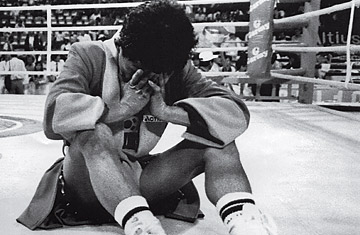
Byun Jong-II sulks on the floor of the boxing ring after losing a match against Bulgaria's Alexander Hristov during the 1988 Seoul Games.
The most important thing in the olympics is not to win but to take part." So goes the Olympic creed. It's a romantic ideal, one that can be hard to follow if you're an athlete who has endured years of intense training only to subsequently fall short in front of millions. Take Evgeni Plushenko. Following his silver-medal performance in men's figure skating, the Russian repeatedly insulted his first-place opponent, America's Evan Lysacek, and all but climbed atop the gold-medal podium ... Wait, he did that too. But Plushenko is hardly the first Olympic sore loser. Athletes have pouted their way home almost since the modern Games began in 1896.
Australian boxer Reginald Baker had reason to suspect foul play when he protested his silver medal in the 1908 London Olympics--his opponent's father reportedly refereed the match. South Korean Byun Jong-Il's complaints were less warranted; in 1988 the bruiser lost a match after he was penalized for head-butting his competitor. Like a petulant child, Byun sat down in the middle of the ring and refused to get up. He stayed put for so long that officials eventually turned off the lights and left him sitting in darkness.
With so many nations vying for respect, it's no surprise that international politics often plays a role in scoring disputes. A botched 1972 U.S.-Soviet basketball game briefly heated up the Cold War when a disputed time-out and a wrongly reset clock effectively handed the Soviets three chances to beat their political rivals. They did, by a single point. The Soviets got the gold, and the U.S. team angrily refused the silver. Thirty years later, when Russia found itself with an embarrassingly small number of medals in 2002's Salt Lake City Games, the Duma blamed U.S. imperialism and considered skipping the closing ceremonies. So much for graciousness in defeat.