

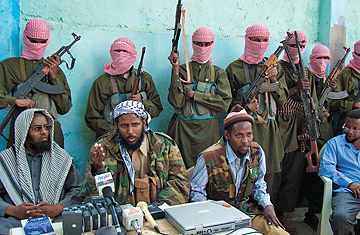
An al-Shabab spokesman, Mukhtar Robow, center, holds a press conference in October 2008.
(2 of 2)
So how to respond? In Somalia, authority is notionally held by the Transitional Federal Government (TFG), led by an Islamist who preaches pragmatic engagement with the West. The TFG was installed by Ethiopia, a principal U.S. ally in Africa, after its forces invaded Somalia in 2006 and toppled an earlier Islamist government whose more extreme members had unwisely declared jihad on Somalia's bigger and more Christian neighbor to the west. But many members of the TFG seem to effectively live in Nairobi. (Exceptions include President Sheik Sharif Ahmed and his Defense Minister, Yusuf Mohamed Siad, a veteran warlord who survived an assassination attempt by suicide bomb in Mogadishu on Feb. 15.) Despite the protection of 5,300 African Union (A.U.) troops — mainly Ugandans and Burundians — the TFG in reality controls little more than a few blocks of Mogadishu. "To defeat the Shabab," says the intelligence officer, "you need a functioning government. That's exactly what they lack."
From outside Africa, the response has been patchy. There is some financial assistance, much of it from the U.S. (The A.U. peacekeepers have cost $160 million so far.) In 2007, the U.S. sent special-operations teams in with the Ethiopians and — says Abdirashid Mohamed Hiddig, a Somali Member of Parliament who assisted the Americans — captured 10 to 20 foreign fighters. Since then, according to Pentagon spokesmen, the U.S. has carried out at least six aerial attacks inside Somalia, killing al-Shabab leader Aden Hashi Farah Ayro, who was hit by a missile in May 2008, and Saleh Ali Saleh Nabhan, the mastermind of the 2002 attack in Kenya, who was killed by U.S. helicopter gunships last September. The U.S. has had no military support from other nations, although some have made contributions to help deal with Somalia's long humanitarian crisis. Only piracy and the threat it poses to world trade have resulted in concerted international muscle. An armada of warships from more than 20 countries now hunts pirates and escorts convoys of merchant vessels in the Gulf of Aden and the Indian Ocean.
All that said, the threat from Somalia needs to be kept in perspective. Al-Shabab is far smaller than the Taliban. "There are bigger gangs in L.A.," says the intelligence officer. It is prone to factionalism and has found it hard to garner support among ordinary Somalis. The U.N. has reported that al-Shabab receives funds and weapons from the Middle East and the Eritrean government. (Al-Shabab fights Ethiopia, and Ethiopia is Eritrea's archenemy.) But that support is small compared with the assistance that extremist groups in Pakistan and Afghanistan have received from radical Islamists around the world. Finally, the risk that Somalia could ignite a wider conflagration across the Horn of Africa — sucking in Ethiopia, Eritrea and even Kenya — is real but, again, nothing like the one in Afghanistan's neighborhood. As U.S. ambassador to Kenya Michael Ranneberger never tires of pointing out, none of Somalia's neighbors are nuclear powers. "We are a little wary of the comparisons," he says.
But in the asymmetrical calculations of terrorism, small numbers aren't the key; determination to do damage is. As Ranneberger concedes, no change in Somalia means "further deterioration." Increasingly bold ways of dealing with al-Shabab are being considered. The A.U. peacekeeping force is being expanded, with the hope of creating a "green zone" in Mogadishu. Hundreds of al-Shabab fighters have been pouring into Mogadishu recently in anticipation of a rumored TFG offensive. Ugandan President Yoweri Museveni has gone further, proposing invading Somalia, occupying the southern port of Kismayu and using it to take the fight to al-Shabab. Memories of the disastrous intervention in 1993 remain sharp, so that is not a proposal that seems likely ever to gain much U.S. support. But it is a measure of the increasing anxiety that Somalia inspires that it is still on the table.