

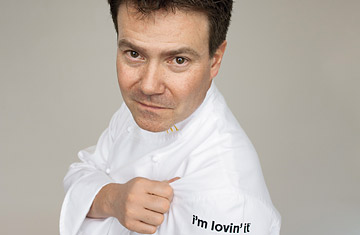
McDonald's chef Daniel Coudreaut is rethinking the food part of fast food
(2 of 3)
The Secrets of Celery Root
The youngest of five, Coudreaut grew up in Ossining, N.Y., not far from New York City. From around age 7, he was his mom's helper at mealtimes and kept a written inventory of ingredients in the pantry. At 14, he got a job washing dishes at a diner where the chef-owner let him look over his shoulder at the stoves. For a while, Coudreaut thought he might want to be in show business, and as a kid he got small roles in TV commercials and an off-Broadway play. He also went to business school, but all the while he kept cooking, and at 28, he enrolled at the Culinary Institute.
In 2004, Coudreaut arrived at McDonald's headquarters, a sprawling, bosky campus in Oak Brook, Ill., outside Chicago. His kitchen, which is on the third floor of the main building, is the sort you would see in the back of house at an expense-account restaurant. It features granite countertops (requested by Coudreaut), a giant Wolf range that cost more than most McDonald's employees make in half a year, and a salamander, a device that professional kitchens use to brown food before serving.
On the day I visited, Coudreaut was experimenting with some very non-McDonald's ingredients: celery root, broccoli rabe, wild salmon, hazelnuts, candied orange rind. There was a huge pot of veal stock simmering on a back burner of the Wolf. He seemed to want to prove his culinary skills, and he did — he made a delicious lunch — but what does any of this have to do with creating food at a real McDonald's?
The answer is that every great manufacturing company runs a crazy R&D department, a place where mad scientists get to fiddle with toys and produce one or two breakthroughs a year. Coudreaut and his staff of 16 consider approximately 1,800 ideas for new menu items each year, but only a couple — or in an atypical year, as many as five — make it onto the menu. Few stay permanently.
Coudreaut and his team spend most of their time playing with ingredients far more practical than broccoli rabe and celery root. Most days, they work with chicken and apples and beef. Facing the kitchen through a glass wall is a large sign reading "It's Not Real Until It's Real in the Restaurants."
That's a highly corporate way to think about food — celery root is certainly real, so real that it's covered in dirt when you buy it at the supermarket — but McDonald's is, after all, a corporation. Coudreaut may be a chef, but his employer is no restaurant. McDonald's Corp. is largely a holding company, a middleman that works between restaurant owners and food suppliers. It provides franchisees with inexpensive, processed ingredients and — this is where Coudreaut's team and other development people come in — a guarantee that new menu items have been tested and tweaked and retested so they can come out looking and tasting roughly the same in every McDonald's in every part of America. (Teams led by other chefs work on other continents; that's why McDonald's has used rice patties as burger buns in Hong Kong and Taiwan and now offers a whole-shrimp sandwich on a steamed bun in Japan.)
And anyway, there is literally not enough celery root grown in the world for it to survive on the menu at McDonald's — although the company could change that, since its menu decisions quickly become global agricultural concerns. Not long after he arrived at McDonald's in 2004, Coudreaut added to the menu an Asian salad that included edamame. The Soyfoods Council, a trade group, immediately got calls from consumers across the nation looking to buy edamame at their grocery stores. "Now you can find it in supermarkets all over," says the council's executive director, Linda Funk, who has even seen the immature soybean pods sold near her small hometown of Janesville, Wis.
Nothing gets on the menu at McDonald's without the approval of hundreds of people: marketers, franchise representatives, engineers who specialize in food hold times, operations managers who know precisely how far refrigerated trucks can drive before food rots and money people who have read reams of market research that has relentlessly focus-grouped every ingredient combination that could be part of a Snack Wrap.