

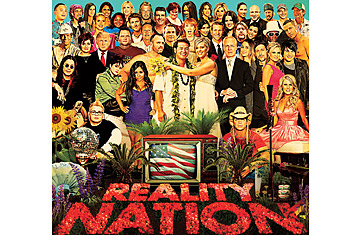
The first thing you notice on MTV's Jersey Shore is the nicknames. Well, that and the hair, and the thongs, and the leathery tans, and the tattoos, and the hair gel, and the hot-tub sex, and the bar brawls, and the lustily embraced Italian-American stereotypes. But then: those nicknames. There's Nicole (Snooki) Polizzi. Mike (The Situation) Sorrentino. And most spectacularly, Jenni (Jwoww) Farley. For future copy editors of academic histories of mass media, that's two syllables, hyphen optional, and three w's, not in a row.
Like the tetragrammatic name of God, the moniker Jwoww has encoded in it everything you need to understand the world we live in today. The idea that an unknown 23-year-old from Long Island would come equipped with a tabloid-ready exclamatory nickname, like J. Lo or P. Diddy, might, in a more self-effacing era, have seemed presumptuous. Now it's just commonsense branding. If you might be on a reality show, you may as well have a name that pops and precedes you like a well-positioned set of silicone implants. (Oh, also: you should get the implants too.)
For the cast of Jersey Shore — gearing up to shoot Season 2 in the next few months — camera-readiness is second nature. These are the children of reality TV. In February 1992 — literally a generation ago — The Real World introduced MTV's viewers to living in public. Ten years ago, Survivor — now in its 20th season — mainstreamed the idea for older viewers. The Jersey Shore–ites have never known a world in which hooking up drunk in a house paid for by a Viacom network was not an option. This year in the coveted post–Super Bowl time slot, CBS showcased not a new drama or sitcom but its reality series Undercover Boss. (The premiere attracted 38.6 million viewers, the most for a post–Super Bowl show since Survivor: The Australian Outback in 2001.) In March, Jerry Seinfeld returns to NBC — as producer of the reality show The Marriage Ref.
Reality is more than a TV genre now. It's the burgeoning career field that led Richard Heene to perpetrate the Balloon Boy hoax, and Tareq and Michaele Salahi to crash a White House dinner, Bravo TV cameras in tow. It's the content mill for the cable-tabloid-blog machine, employing human punch lines like Rod Blagojevich, the disgraced governor turned contestant on Celebrity Apprentice. It's everywhere. When Scott Brown won an upset Senate victory in Massachusetts, he was joined onstage by his daughter Ayla, an American Idol semifinalist from Season 5.
In 1992, reality TV was a novelty. In 2000, it was a fad. In 2010, it's a way of life.
The Evolution of a Genre
The summer of the first Survivor season, I wrote a cover story about it for this magazine. The concerns that the show's popularity raised seem so quaint now: a professor worried its success would lead to "Let's try a public execution. Let's try a snuff film." We're still waiting for those. But Survivor is still on — considered, together with the likes of Idol and The Amazing Race, to be relatively tame, even family-oriented entertainment.
At the time, there were a handful of reality shows on TV. Since then, we've seen 20 Survivors, 16 Amazing Races and 14 The Bachelors. We've seen Chains of Love, Rock of Love, Flavor of Love and Conveyor Belt of Love. American Candidate, American Gladiators and American Inventor. Anna Nicole, Kathy Griffin and Britney & Kevin. Design Star, Rock Star, Nashville Star and Dancing with the Stars. Joe Millionaire, Average Joe and The Joe Schmo Show. Shark Tank and Whale Wars, The Mole and The Swan. Fear Factor, The It Factor and The Benefactor. (Coming in 2011: Simon Cowell's The X Factor!)
You can break down reality TV roughly into two major subgenres. The first — the big competition-event show — descends from Survivor and includes most of reality's big hits: Idol, The Bachelor, The Amazing Race, The Biggest Loser, Project Runway. These shows mainstreamed reality TV for bigger, broader (and older) audiences by applying it to familiar genres: game shows, singing competitions, cook-offs, dating shows.
The other type of reality show descends from The Real World's naked voyeurism. Some of these shows are about celebrities, former celebrities or pseudo celebrities. Some are about therapy, about work or about parenting. And many are just about life. Bravo's Real Housewives series is still spreading across the country like Cheesecake Factory franchises. (The Salahis snuggled up to the President as candidates for The Real Housewives of D.C.) When Jon and Kate Gosselin drew 10 million viewers to watch their marriage end on TLC, reality TV proved it wasn't going into middle age quietly.