

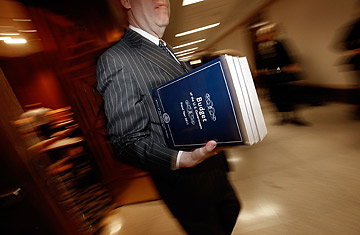
The budget is the main arena in which the nation as a whole decides on the allocation of resources. What we spend money on--and what we don't--reflects what we value as a nation. But making those choices isn't at all simple. It is in the federal budget that the breakdown of consensus in America is most vivid and most dangerous. One side of the political divide wants to cut taxes and shrink existing public services (including support for the poor) in the name of cutting wasteful government programs and insisting that the poor solve their own problems. The other side wants to increase public spending on social and economic needs--the poor, the unemployed, infrastructure, education and the environment--even as it remains unclear on how to fund the outlays.
With these divisions unresolved, we've landed in a first-rate mess. Compared with those in other rich countries, taxes in the U.S. are low. Yet government spending is persistently higher than taxes: the budget deficit is at a record high for peacetime, and Washington is utterly paralyzed when it comes to addressing urgent needs. The only thing that reliably grows in our economy is the public debt.
During the first full budget year of the Obama Administration (fiscal year 2010, which runs from October 2009 to the end of September 2010), both sides "won" yet again: taxes were cut; spending was increased. According to the latest projections by the Administration in presenting the fiscal year 2011 budget, the deficit is now expected to reach $1.6 trillion, an astounding 10.6% of gross domestic product (GDP). Some of that reflects the downturn in the business cycle, which cuts into tax revenue while boosting unemployment compensation, bank bailouts and other spending. Yet there's nothing temporary about the enormous deficits. The Obama budget office projects megadeficits for years to come--as high as $752 billion, roughly 4% of GDP, in 2015--despite some rosy economic and budgetary assumptions. Meanwhile, as the Treasury borrows to fill the gargantuan gap between revenue and outlays, the stock of government debt is soaring. In fiscal year 2010, the Obama budget office projects that the public debt will increase by $1.75 trillion. That amounts to roughly $15,000 per household. Through 2015 the cumulative rise in the debt is projected to exceed $6 trillion.