

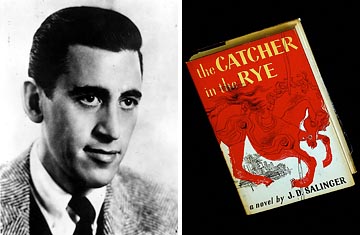
American author J.D. Salinger, who wrote The Catcher in the Rye, died of natural causes at his home in Cornish, N.H., on Jan. 27, 2010. He was 91
Take the little paperbacks down from the shelf, and you can hold the collected works of J.D. Salinger--one novel, three volumes of stories--in the palm of one hand. Like some of his favorite writers--the Greek poet Sappho, whom we know only from ancient fragments, or the Japanese writers of 17-syllable haiku--Salinger was an author whose large reputation pivots on very little. The first of his published stories that he thought good enough to preserve in a book appeared in the New Yorker in 1948. Seventeen years later, he placed one last story there and drew down the shades. From that day until his death on Jan. 27 at age 91 at his home in Cornish, N.H., Salinger was the hermit crab of American letters. When he emerged, it was usually to complain that somebody was poking at his shell.
Salinger's only novel, The Catcher in the Rye, was published in 1951 and gradually achieved a status that made him cringe. For decades, the book was a universal rite of passage for adolescents, the manifesto of disenchanted youth. (Sometimes lethally so: after he killed John Lennon in 1980, Mark David Chapman said he had done it to promote the reading of Salinger's book.) Holden Caulfield, Salinger's petulant, yearning young hero, was the original angry young man, created at the very moment that American teenage culture was being born. A whole generation of rebellious youths discharged themselves into him.
Jerome David Salinger was born in New York City on Jan. 1, 1919, to a Scottish-born mother and a Jewish food-importer father. He flunked out of or ran away from a series of private schools, graduating from Valley Forge Military Academy outside Philadelphia--later the model for Caulfield's despised Pencey Prep--before drifting back to Manhattan with the general idea of becoming a writer. A promising career would be briefly derailed by a grueling slog through wartime Europe with the U.S. infantry, but by 1946 he was back in Manhattan and soon writing regularly for the New Yorker.
By the time The Catcher in the Rye was published, to generally exultant reviews and a seven-month stint on the New York Times best-seller list, Salinger had already moved past adolescent angst and on to a dissatisfaction with a world he found increasingly irrelevant and intrusive. In 1953 he bought a small, spartan house in Cornish; by the fall of that year, he had built a high wall around it.
But while Salinger lived as a recluse, he was never inclined to be a hermit. He married a 19-year-old Radcliffe student named Claire Douglas in 1955; they had two children together before divorcing in 1967. Salinger soon enticed another young woman, a Yale freshman named Joyce Maynard, to join him in exile. Her memoir, At Home in the World, provides a picture of Salinger in later life as a man preoccupied with homeopathic medicine and old Hollywood movies who wrote every day but then stored the unpublished works in a giant vault. After 10 rocky months, Salinger abruptly called things off.