

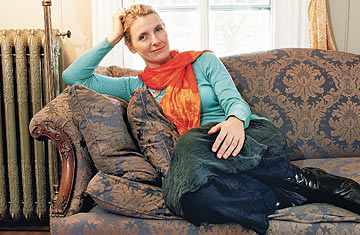
Author Elizabeth Gilbert
Once upon a time in the annals of women's stories, getting married was the fairy-tale ending. These days, marital ambivalence rules the literary scene. December brought Julie Powell's new memoir, Cleaving: A Story of Marriage, Meat and Obsession (Little, Brown; 307 pages), in which the Julie & Julia author tells the sad, sordid tale of the recent years she spent butchering pigs, cows and her husband's heart. Meanwhile, in a New York Times Magazine story, writer Elizabeth Weil detailed her efforts to subject her "perfect union" to every kind of therapeutic scrutiny available in Northern California. Her goal of complete marital introspection--needed or otherwise--inspired heated holiday-party conversations and terror at the thought of the memoir to follow, as well as giving single women everywhere a new appreciation of their unburdened ring fingers.
Elizabeth Gilbert does these reluctant wives one better. The author of Eat, Pray, Love returns with Committed: A Skeptic Makes Peace with Marriage (Viking; 285 pages), in which she is a vehemently wary second-time bride, due to be dragged down the aisle by Uncle Sam's immigration henchmen, who will otherwise toss her beloved, Brazilian-born "Felipe," as she calls the older man she met in the last section of EPL, out of the U.S. for good. They hadn't planned to marry. Like Gilbert, Felipe had endured a hard divorce, and they were content to be "lifers" together. But a helpful Homeland Security officer prescribes marriage as the only certain way out of Felipe's immigration dilemma, and the couple agree that they love each other enough to do it.
Gilbert cites statistics, scientific studies and her painful experience with her first marriage--the impetus for the worldwide spiritual ramble of EPL--as her reasons for not wanting to tie the knot. She demonstrates how the institution threatens her independence and the well-being of many women. Her fears hold up even when she's considering union with a man who loves her, excuses her memoirist tendencies and has been known to tell her that the curves of her body "look like sand dunes."
But whereas in Eat, Pray, Love the journey was what mattered, the end of Committed is, as of page 18, a foregone conclusion. As Gilbert puts it, she and her lover are "sentenced to marry." This makes the book a supreme act of navel-gazing, even for a memoir. While the legal complexities are being worked out, the two kill time by traveling together. Along the way, Gilbert, ever the good journalist, gathers string on marriage and love from various sources, including the humble Hmong women of North Vietnam, seagulls, a humble frog-farming family in Laos and her humble 96-year-old Grandma Maude back in Minnesota. (Gilbert practices humility with vigor, even when sweetly patronizing Third World cultures.) Her process is exhaustive, and the results are exhausting, though some of her points are astute. This slog through one woman's relationship angst feels, in the end, like much ado about nothing.