

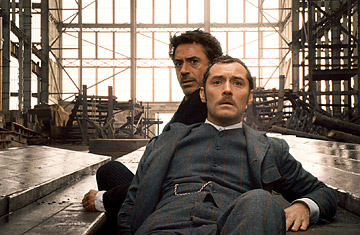
Robert Downey Jr., left, and Jude Law star in Sherlock Holmes.
(2 of 4)
With Daniel Day-Lewis, Nicole Kidman, Penélope Cruz, Judi Dench, Marion Cotillard, Kate Hudson, Fergie and Sophia Loren
Poor Guido Contini. He's a famous Italian director with a producer and technical staff ready to bring his movie dream to reality and with beautiful women lavishing their love on him, begging him just to use them. So of course Guido is miserable--because at the moment he has no clue what his film will be. Rhapsodies, fantasies have sprung from his brain before, but now, as a creative filmmaker, he can't get it up.
This portrait of artistic exhaustion came from Federico Fellini, the maestro of Italian cinema (La Strada, Nights of Cabiria, La Dolce Vita), who in 1963 turned his notion into the bold comedy-drama 8½. The movie was a landmark for all sorts of reasons: its cunning mix of fantasy, memory and backstage reality; its placing of a film director at the center of his own work; and its facility in mining human comedy out of suicidal depression. Besides triggering a slew of navel-gazing movies about movies, 8½ inspired the 1982 Broadway musical that is the source of Rob Marshall's gaudy, star-laden, dispiriting new film.
The problems begin at the front. As played by the Oscar-winning Day-Lewis, Guido is coiled, wary, going nowhere fast in the haze of his own cigarette smoke. Marcello Mastroianni, who originated the role, was such a natural charmer--so Italian--that he made indolence attractive and perpetual sexual adolescence not a flaw but a goal. Day-Lewis' vibe is not Mediterranean but Nordic. He's closer to Ingmar Bergman, the solemn Swede, than to the ebullient Fellini, just as the movie is more akin to All These Women, Bergman's sour comedy about a musician's frustrated mistresses, than to 8½.
Famous for the obsessive dedication he invests in his roles, Day-Lewis is so intense that he can't unleash the showmanship--the limelight love--that has to animate any musical star. Smiling is an ordeal for him, singing an imposition, dancing a form of enforced calisthenics.
And all his women? They are a stunning lot, including five Oscar winners, and when they get to strut, they put on quite a show: the writhingly sexy Cruz, the suddenly belting Dench and, in a nice little surprise, Fergie as a zaftig whore from Guido's youth. But they are ornamental, not organic, to the plot; they illustrate points without advancing them. Their practiced glamour doesn't quite fill the vacuum they're working in.
Only Cotillard, as Guido's wife Luisa, is in command of her character, whether she's singing, speaking or just staring darts at her philandering mate. Pain has rarely seemed so proud, or hurt so regal, as in Cotillard's rendition of the melancholic "My Husband Makes Movies." It's a moment of emotional truth at the heart of this chic, hollow enterprise. The rest is vaudeville.
It's Complicated
Directed by Nancy Meyers
With Meryl Streep, Alec Baldwin and Steve Martin