

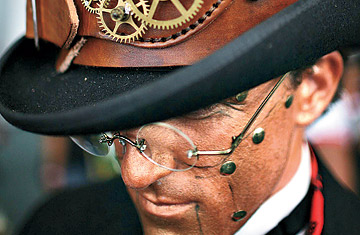
A fan shows off a steampunk costume at Comic-Con in San Diego.
(2 of 2)
You can read the steampunk movement as a response to the realities of modern consumer technology. Take the iPhone: its form gives no clue as to its function or who made it or where it came from. There are no screws. You can't hack it. It's perfect, but it might as well have been made by aliens and fallen to Earth in an asteroid.
The same way punk took back music, steampunk reclaims technology for the masses. It substitutes metal gears for silicon, pneumatic tubes for 3G and wi-fi. It maximizes what was miniaturized and makes visible what was hidden. Where the iPhone is all stainless steel and high-gloss plastic, steampunk is brass and wood and leather. Steampunk isn't mass-produced; it's bespoke and unique, and if you don't like it, you can tinker with it till you do.
Steampunk is like a snapshot from the last moment in human history when technology was intelligible to the layman. "The Internet is global and seemingly omniscient, while iPods and phones are all microscopic workings encased in plastic blobjects," Westerfeld says. "Compare that to a steam engine, where you can watch the pistons move and feel the heat of its boilers. I think we miss that visceral appeal of the machine."
"Plus," he adds, "those Victorians dressed a lot better than we do."