

(2 of 2)
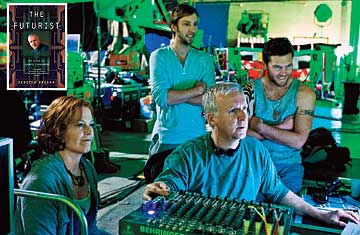
The director's last movie had involved creating the largest and most meticulously detailed set ever made: a scale replica of the Titanic. By contrast, Avatar's performance-capture soundstage, which is called the volume, looked like a Saturday Night Live skit about postmodern theater. Instead of sets, gray-painted polygons and the occasional tree were moved around to create topography. For the computer-generated (CG) scenes, which make up about 60% of the finished film, the cast wore clingy Lycra bodysuits covered in markers that were recognized by the 102 cameras on the warehouse ceiling. They donned skullcaps rigged with tiny cameras that imaged their faces. Thanks to software created for the film, the actors appeared on Cameron's monitor in real time as their alien counterparts.
With more than 2,500 special-effects shots, the bulk of the man-hours on Avatar were spent not on a stage but in a dark viewing room in Los Angeles, in teleconferences with collaborating artists from Peter Jackson's Weta Digital studio in Wellington, New Zealand. The real world was being used to inform the fictional one: an energy map of the Pandoran forest was modeled on rat neurons; hours were spent getting alien sap to drip precisely right.
And as much as he could, Cameron tried to place the cast emotionally inside the environment of Pandora. He took the actors to Hawaiian rain forests and shot reference footage for them to use as sense memory. To help them feel an explosion, he boomed a noise over amplifiers, threw foam particles at them and whacked them with a padded jousting pole. To approximate Pandora's moss-covered terrain, he laid plastic sheets on the floor, forcing the cast to walk gingerly. When Zoe Saldana, who plays Jake's Na'vi love interest Neytiri, was "riding" a flying creature, she clung to a giant gray hobbyhorse rocked on a gimbal by grips. For scenes that combined live action with CG, Cameron used a new tool called a Simulcam, which allowed him to see actors playing in exotic CG surroundings in real time. Cameron's goal was to shoot as if he were filming a documentary on another planet. It was the kind of filmmaking environment that required both imagination and patience. A crew member wrote a set catchphrase on a whiteboard: "It's Avatar, dude, nothing works the first time."
Avatar Onscreen
Audiences got their first look at Avatar footage in July at San Diego's Comic-Con. When the trailer went online on Aug. 21, demand was instantaneous, quickly making it the most downloaded trailer at Apple.com The Avatar footage triggered a record 4 million streams in its first day. But the reaction wasn't all glowing. Some commenters likened the Na'vi to George Lucas' reviled CG character Jar Jar Binks, others to the '80s TV cartoon Thundercats. Those who saw the footage in theaters (it screened in select IMAX locations) were considerably more impressed, but the initial hype and interest that had surrounded the project were giving way to a backlash. This was a place Cameron had been before, on Titanic — only instead of bloggers and online commenters, back then it was the mainstream media who snickered at his ambition.
One script element Fox had initially objected to was Cameron's failure to explain unobtainium, the precious resource that sends humans to Pandora to strip-mine the planet ruinously. Unobtainium is a joke term engineers have used for decades to describe any needed material that is rare, costly or difficult to obtain. For Cameron, the specificity of unobtainium is not important, and despite Fox's objections, he never explains in the movie what makes unobtainium worth the trouble of interstellar travel. But the answer to that mystery is that the substance's room-temperature superconducting properties make it the key to cheap power generation back on Earth, where all the oil has run out. Unobtainium is crucial to running ships like the ISV Venture Star, which delivers humans to Pandora. The irony is that the more unobtainium humans mine on Pandora, the more they will be able to travel there. It's a devastating feedback loop.
Like all of Cameron's movies, Avatar can be watched as pure escapist entertainment or as a dire warning about humanity's current path. But here, for the first time, Cameron's future vision has not been limited by the strictures of a real-world movie set. The result is his most fantastical film, one that hews to the rules of science in its creatures and environments but not to the limitations of the physical world of props and the human body. Of course, it still needs to draw human bodies to the theater. Its trickiest special effect is yet unseen: meeting the expectations that await it.
From The Futurist: The Life and Films of James Cameron. Copyright © 2009 by Rebecca Keegan. To be published by the Crown Publishing Group, a division of Random House