

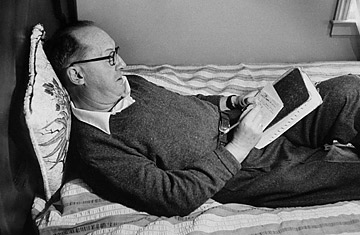
Author Vladimir Nabokov
(2 of 2)
For readers who are devoted to Nabokov (I'm one), The Original of Laura affords its own ecstasies. It comes at you as a reprieve, a final appearance from an old friend you thought was already gone for good. It's a shambles, a heap of shards, but they're Nabokov's shards and no one else's: the "nasty compassion" the partygoers direct at a drunken Flora; the "alien creams" Flora spots in someone else's bathroom (recalling the "solemn pool of alien urine" deposited by Mr. Taxovich in another bathroom in Lolita); the playful half-rhyme of belie and belly; the perhaps overly wink-winky inclusion of a pedophile named Mr. Hubert H. Hubert; and one lost, evocative phrase off by itself in the upper margin of a card, without a context--"the orange awnings of southern summers."
Flora's surrender to lazy, loveless sexual pleasure and Philip's intensely strange abdication of bodily life together make, or would have made, The Original of Laura a melancholy meditation on our fleshly predicament. And what else? The novel's title refers to a novel-within-a-novel called My Laura, about a character based on Flora. This in turn rhymes with Aurora, the name of an early love of Philip's whom Flora physically resembles, creating a chain of resemblances and echoes that leads us ... where?
We'll never know. The Original of Laura is a beautiful ruin, like the Venus de Milo, not a novel. To pretend otherwise is wishful thinking, no different from Philip's belief that he can master death. At some moments the book seems to anticipate its shattered future--Nabokov compares Flora to "an unwritten, half-written, rewritten difficult book." That's part of her appeal and, oddly, part of Laura's too. You admire what you can see, and you dream about what might have been.