

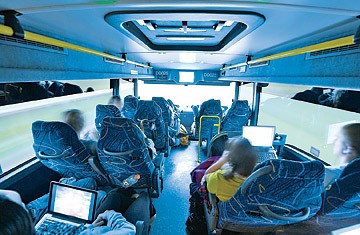
Inside a MegaBus headed from Minneapolis to Madison, Wis.
I can count on one hand the number of times I have traveled between cities on a bus. And let's just say that when I think back on those hulking motor coaches--from sullen rides to sleepaway camp to a terrifyingly fast tour abroad with an unpleasant-smelling driver--none of the memories are very nice. So when my ultra-cool 29-year-old cousin started raving about her regular bus trips from New York City to Philadelphia, where her fiancé is in grad school, I figured maybe it was time to review my old bias.
Turns out that bus travel, at least in the Northeast and Midwest, has become a hip, and hiply budget-conscious, mode of transport. Book early enough on some of the sleek new lines, and you can travel from city to city for as little as $1. And forget the images of desolate bus depots; the post-Greyhound generation of buses often pick up passengers at convenient curbside locations. A bunch of coach lines now compete for fare-surfing customers on BusJunction.com by touting such amenities as power outlets and free wi-fi. Some even show movies.
"Who wants to drive when you can watch movies and play with your computer?" asks Joe Schwieterman, a DePaul University professor who specializes in urban planning and transportation. He recently published a study on intercity U.S. bus travel that showed a nearly 10% jump from 2007 to '08. "As Amtrak and the airlines have struggled with incorporating wireless, we think that's a big part of why it's suddenly cool to jump on the bus," he says.
That, and the jaw-dropping prices. The British-owned MegaBus, which arrived in the U.S. in 2006, offers a $1 fare to at least the first passenger to book a seat on each bus. BoltBus, a joint venture launched last year by Greyhound and Peter Pan that covers Washington, Baltimore, Philadelphia, New York City and Boston, offers the same $1 deals as MegaBus, whose routes include the Northeast corridor and major college towns in the Midwest. BoltBus caps fares at $25 each way. This means a weekday ride from New York City to Boston costs about a third as much on a bus as it does on Amtrak or JetBlue.
For long trips, of course, buses can't compete with trains and planes. The sweet spots, the most traveled routes, are those under 300 miles (480 km)--e.g., Chicago to Ann Arbor, Mich. But the surprisingly green coaches far outshine other vehicles in eco-efficiency. When you combine passenger occupancy with mileage per gallon, bus travel is four times as energy-efficient as car or air travel. Which helps explain its robust growth in a down economy. At MegaBus, sales have grown 60% in the past year.
On a recent Friday afternoon, my partner and I lined up on 34th Street in Manhattan and took a BoltBus to Philadelphia for date night. The bus left on time and was packed with people hunched over their netbooks and PDAs. Even the one bit of trash I saw was upscale: a lipstick-smudged Starbucks cup. And the $20 round-trip fares made it a lot less painful to pay our babysitter when we got home.