

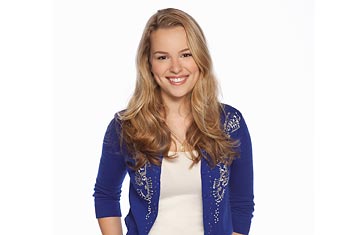
A wholesome celebrity- academy graduate, Bridgit Mendler, 16, is the star of the next new Disney Channel sitcom.
(2 of 3)
That's why the Disney Channel's ability to mint teen stars is so central to the company's future and why Rich Ross, former head of the Disney Channel, was recently tapped to replace longtime studio chief Dick Cook. In many ways, Ross ran his outfit like an old-school movie studio. The channel has always found young stars. Shia LaBeouf got his first break there, as did Hilary Duff and--way back in 1993--Britney Spears. But only in the past few years has Disney mastered how to hang on to them, to keep them from getting away like LaBeouf, tiring of Disney like Duff or being churned into tabloid chum like Spears. And only since High School Musical and Hannah Montana has it learned how to supersize them.
"As we've gotten smarter about how to build talent, we've created more opportunities for them within the company," says Gary Marsh, president of entertainment for Disney Channels Worldwide, who remembers walking Duff over to the music division and introducing her to Bob Cavallo, head of Hollywood Records. "For many people, TV is an endgame. For us, TV has simply become a launchpad to opportunities elsewhere in the company. By creating these opportunities, [we make sure] the talent is more interested in engaging longer with the company."
As launchpads go, a half-hour comedy is pretty economical. By the end of the first season of Hannah Montana, Cyrus was a star. Assuming the company spent about $600,000 for each of the 26 episodes, it cost Disney about $15.6 million to set her up. Three seasons, more than 8 million CDs, $225 million worth of movie tickets, two concert tours, a best-selling memoir and 15 million Hannah Montana books later, says Disney, she's worth billions of dollars to the company. Of course, the channel reduced its risk considerably by casting the girl it wanted to develop into a famous pop singer in--um--a show about a girl who's a famous pop singer. Jonas, starring three real-life musical brothers, is about brothers who are rock stars. On Lovato's show, Sonny with a Chance, she's a Midwestern girl who gets to be on a TV show.
If that seems like a no-lose formula, it's worth remembering that one of the biggest entertainment corporations in the U.S. (2008 revenues: $37.8 billion) is relying on teenagers for a major source of revenue. Even worse, on celebrity teenagers. They grow up, change their minds, get less cute, rebel, make choices their fans' parents don't approve of. (Seminaked Vanity Fair shoot, anyone?) They're on Twitter and Facebook. The opportunities for doing something irresponsible are legion.
Disney Channel is taking extraordinary steps to make its modern Mouseketeers' stay at the Mouse House as long--and mutually enriching--as possible. Most recently, this includes instituting a Talent 101 seminar. Young actors whose shows have been filmed but not yet aired are required to attend Talent 101 with a parent. It includes instruction from security experts, media-relations consultants and psychologists. Mendler is one of its first graduates. "We learned how to answer questions from the media and how your family has to be your support," she says. "I was surprised at the amount of security some people recommend--to the degree where you don't even have a mailbox at your home."