

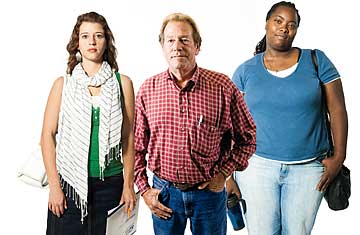
Coping with bills due, dreams deferred and the need to plot a new life.
(5 of 5)
But we've also got to take a careful look at how jobs are created--and what sorts of jobs Americans want to do. The most likely sources of job growth in the next few years are going to be confined to health care, education and restaurant/hospitality services. But we can't nurse, teach and barista our way to real national power. Service jobs alone can't support growth and innovation--which will be essential as we struggle to pay off a historic national debt and fund the retirement of the baby boomers. So in addition to a retraining push, a sensible set of policies would shift the landscape of job creation. It would transfer money out of Wall Street and into community lending to encourage the formation of new companies. It would create local business pods in which neighbors ask, What do we do well here, and how can we do it better? Some of the world's most skilled machinists live in the American Midwest. But their skills are geared to a dying auto industry, and with no bank credit for start-ups and no way to organize, they have no chance to transform themselves into a workforce for globally competitive precision-manufacturing firms.
Is there really a demand for machinists? Yes--even in a recession. One rough calculation found that about a million high-skilled jobs remain unfilled. This is why a fresh approach to job-making, one that focuses on mastery of skills instead of simple button-pushing, matters. "If we go back to the old ways," says sociologist Richard Sennett, who has probably studied the quality of American working life as thoroughly as any other scholar in the past few decades, "we just go back to a very unsustainable path."
The President's advisers grasp the urgency of the task. "Would I like Americans to be more skilled?" Summers muses. "Yes. Would I like to be able to increase skill faster than is likely to be possible? Sure. Would I like a larger fraction of good entrepreneurial ideas to happen in the U.S.? Of course. There are millions of people who need work." But Summers need only read his own research to recall that traditional government policies are not going to pull us out of the job trap.
One of the tropes about Bush's 9/11 and the wars that followed was that they conveniently allowed him to deal with problems bedeviling his young Administration: a lack of focus, difficulty reforming the U.S. military, trouble articulating a global vision. Obama now faces a host of problems of his own: weakening political will, an inevitable "What next?" after health care, a base that has lost energy. His 9/11 is just the sort of transcendent issue that can reconnect him to the theme of hope and change. A tough challenge? You bet. But as Obama's presidency unfolds, it will be the most vital one for him to meet.
Ramo is managing director of Kissinger Associates and author of The Age of the Unthinkable