

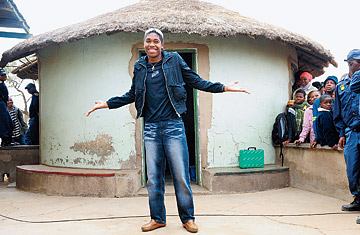
Nine days after she won the women's 800-m world championship as an all but unknown in Berlin, Caster Semenya returned home to the plains of Limpopo, the northernmost province of South Africa, to escape the uproar that had enveloped her since she'd crossed the finish line. Semenya, 18, finds herself as not only one of the world's best athletes but also among its most controversial, under investigation by the International Association of Athletics Federations (IAAF) not for cheating or doping but for allegedly not being female. "Coach used to tell me there are many ways to kill a cat," she told a crowd outside her parents' thatched, mud-walled home. "I have killed it. That's why I am champion." More confusion was provided by Semenya's ancestors in the Sepedi tribe, who were in the habit of naming villages in the area after planets. Semenya's people, it turns out, come from Venus and Mars.
In Berlin, Semenya looked as if she ran a different race than the rest of the field did, finishing 2.45 sec. — a bus length — ahead of her nearest rival. But it wasn't just her performance that set her apart. While the other runners sported ponytails and nail polish, Semenya was conspicuously masculine. After the final, the general secretary of the IAAF, Pierre Weiss, explained that inquiries into Semenya's gender would involve a gynecologist, a psychologist and specialists in hormones and internal medicine. If they concluded Semenya was male, Weiss said, "we will withdraw her name from the results." Said Italian Elisa Cusma Piccione, who placed sixth: "For me, she's not a woman. She's a man."
Actually, Semenya doesn't run like a man. Her time wouldn't even have gotten her into the men's heats in Berlin. But in the flesh — at a homecoming in Polokwane, Limpopo's main city — Semenya's appearance was just as startling as it was on the track. At first, she rode high in an open-topped car, blushing and waving like a prom queen. A few minutes later, it was a burly-looking Semenya who rolled up to a microphone, baseball cap on backward, and thanked the crowd in a cracked baritone. Family and friends admit there is more than a hint of gender ambiguity about Semenya. "She looks like a boy," says her elder sister Nico, 24, at the family home in Masehlong.
Science recognizes androgyny. Androgen-insensitivity syndrome (AIS) describes a genetic male who is resistant to androgens, the male sex hormones, which include testosterone. In a male with AIS, the testes may never descend, the genitalia may resemble a female's, and while the body produces testosterone, it is insensitive to its effect, prompting it to produce more. But though science acknowledges gender can be a continuum, sport — which requires like to compete against like — does not. A decision on where to draw the line, and whether Semenya is blessed by natural gifts or unfairly endowed with a freakish biological advantage, can only be subjective, says Malcolm Collins, chief scientist at the Research Unit for Exercise Science and Sports Medicine in Cape Town. From a scientific point of view, "it would be very difficult to draw a clear line in the sand and say this is it," he says.
Still, people tend to regard gender as a straightforward affair, and South Africa is a particularly hard place to be the "other." Apartheid's legacy has been an aggressive racial division that segregates ethnicities into plush suburbs and ghettos. The manner in which South Africa defended Semenya only underlines how obsessed with difference the country remains. When Semenya returned from Berlin, she was met by the leader of the ruling African National Congress Youth League, Julius Malema, who proclaimed the issue was not gender but race: Semenya was a victim of white officials, white media and unpatriotic white South Africans. And yet one miracle of Semenya's story is that in a nation of little tolerance and where apartheid crushed self-respect, Semenya's achievements have brought her both. Because in Berlin, as she broke from the pack and the crowd could measure her difference in astonishing distance, the other became not weird but wonderful.
— With reporting by Eben Harrell and William Lee Adams / London and Megan Lindow / Cape Town