

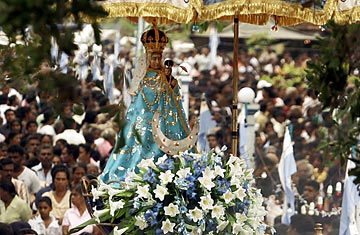
Thousands of Sri Lankan Christians gather at the sacred Madhu Shrine, located in a former war zone that is 144 miles northeast of the capital, Colombo
The feast of the assumption is one of the holiest days on the Roman Catholic calendar, marking the time the Virgin Mary is believed to have been physically taken into heaven after death. On Aug. 15, Sri Lanka's Catholics celebrated a second miracle: the survival of a 500-year-old statue of the Virgin through a quarter-century of conflict and its safe return to the jungle shrine it calls home.
For more than 25 years, the village of Madhu--185 miles (300 km) from Colombo, the capital--was a battleground of the civil war between the predominantly Sinhalese government and the separatist Tamil Tigers, which killed an estimated 70,000 people. Some brave believers made the pilgrimage during lulls in the fighting, but their numbers were few and their trips brief. "We came, we worshipped, we left--that was it," says Lesley Fernando, an ethnic Sinhalese who visited during the war's fragile truces. It was not until April 2008 that the Sri Lankan military gained control of the shrine; the Tigers, who fought for a separate Tamil homeland, were finally crushed this May.
The Madhu Matha--the Mother of Madhu--occupies a unique place in Sri Lanka's spiritual cosmology. Only about 7% of the population is Christian, but the shrine counts adherents among both the mostly Buddhist Sinhalese and the predominantly Hindu Tamils. As such, the first Feast of the Assumption since the fighting ended was a rare opportunity for members of both groups to come together.
As the feast day approached, some 500,000 pilgrims thronged the road to Madhu, passing security checkpoints and bomb-damaged buildings in vans, trucks, buses and three-wheeled tuk-tuks. Along the way stood camps where some of the more than 280,000 people who were displaced by the last phase of the fighting now live. Red skull-and-crossbones signs warned of land mines in the jungles on both sides of the road. At the shrine, the constant hum of prayers and hymns rose above the rustling of pilgrims' feet. Piles of sandals and shoes accumulated by the doors as visitors joined the long line that slowly snaked around the church, allowing them to touch the altar where the venerated Madhu Matha stood.
The statue--a 2-ft. (61 cm) icon of the mother of Jesus, believed to be of Indian origin and brought to Sri Lanka in 1500--is renowned for its protective powers. "This is holiest of the holiest for us. The Virgin has always kept us safe," says Benedict Perera, 70. The church came through the war largely unscathed; by 2007, some 10,000 people had taken refuge in its compound. But in April 2008, as the military advanced, Madhu's priests received orders from their bishop to move the Virgin from the front lines. They spirited away the statue early one evening amid constant shelling and rain. "Nothing, absolutely nothing happened to the statue," recalls the Rev. S. Emilianuspillai, then the shrine's caretaker. "We kept moving."
The Mother of Madhu had been in danger before. In the 17th century, Dutch Protestants tried to eradicate the Catholicism brought to the island by the Portuguese. The Virgin Mother was secreted away until 1670, when it was rediscovered by a woodcutter, miraculously hidden in the trunk of a tree. (In a corner of the church, pilgrims now fill bags and handkerchiefs with holy earth from the spot where the tree sprouted.)