

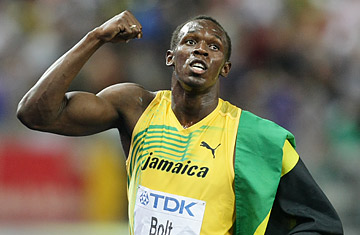
Jamaica's Usain Bolt celebrates winning the 100-m final at the 12th IAAF World Championships in Athletics, Berlin
If you blinked, you may have missed him. On Aug. 16 in Berlin, Usain Bolt shocked the world by running the 100-m dash in 9.58 sec.--eclipsing his own world record by more than a tenth of a second. The time cemented the lanky Jamaican's spot in sprinting lore and tightened his grip on one of the most fabled honorifics in sports: the world's fastest human.
Fewer than 20 men have staked claim to the title since Donald Lippincott, a University of Pennsylvania undergrad, first earned the honor with a 10.6-sec. time in the 100 m at the 1912 Stockholm Olympics. If Lippincott was an unlikely trailblazer, the next record breaker, Charley Paddock, was an eccentric one, known as much for his prerace cocktail of sherry and raw egg as for his 10.4 speed. His mark, set in 1921, stood until 1930. Six years later, at the Berlin Olympics, Jesse Owens--a Cleveland native who once outraced a horse--earned four gold medals under Adolf Hitler's scornful gaze at the same stadium where Bolt would run seven decades later. Owens went on to pass the torch to speedsters like Bob (Bullet) Hayes, who parlayed his wheels into a career with the Dallas Cowboys, and two-time world's fastest human Carl Lewis.
Shaving fractions of a second off a speed at which humans aren't built to go isn't easy, and some have buckled under the pressure. In recent years, world-record holders Ben Johnson, Tim Montgomery and Justin Gatlin have had their titles stripped after becoming embroiled in steroid scandals. But in Bolt, a telegenic 23-year-old who attributed his gold medal in Beijing to a diet of chicken nuggets, track may have found its freakishly fast savior--one who claims he can go even faster. This time, he has few doubters. "If he says 9.4," an observer responded, "it's probably on."