

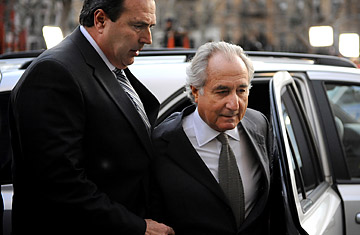
Bernard Madoff arrives at federal court in New York City on March 12, 2009
The jail doors had barely slammed behind Bernie Madoff before publishers were racing to be first in the scandal's inevitable book sweepstakes. The victims of Madoff's Ponzi scheme, in which more than 4,000 clients lost $65 billion, may have been wiped out, but there is still a chance to make a killing on a best seller. After intense jockeying for position, three Madoff tomes will hit the streets on Aug. 11, about 150 years before Bernie does.
Meticulous and ever more mysterious as his fame grew, Madoff hawked his investment fund to a largely Jewish clientele, eventually sucking in large European banks too. Promising unwavering 10%-to-12% returns whatever the market, Madoff became known as "the Jewish T-bill," as in risk-free. Of course, there was no investing. For more than two decades, he used an ever larger stream of money from new investors to pay off earlier ones. His résumé supplied a perfect cover: former head of Nasdaq, a tech wizard who brought computerization to Wall Street.
The books trace the evolution of his sociopathy: friends remembering shady incidents from earlier in life--and that his parents were also crooked traders. But nothing about his IQ, or any evident evil, portended the breadth of his later crime. On the surface, Madoff's legitimate trading business gleamed. But in the off-limits-to-his-staff, low-tech office on the secluded 17th floor of Manhattan's Lipstick Building, Madoff worked darker magic.
Too Good to Be True: The Rise and Fall of Bernie Madoff by Erin Arvedlund (Portfolio) carefully details how Madoff's marks, some of them supposedly sharp hedge-fund managers, became feeder funds for Madoff's enterprise by willfully or negligently failing in their due diligence to check out the bogus Madoff claims. "The same people did more research on buying a car than they did on the man who handled their money," she writes.
Arvedlund has bragging rights: her story in Barron's in May 2001 was an early warning, but ultimately it failed to foil the plot. Her account will delight those more interested in the scam than in the man. Arvedlund goes down the list of entities that were on notice about Madoff's "trading," and she holds particular contempt for the all-but-absent SEC ("one of the most dysfunctional and inept periods in the commission's history"). Also in her sights: Fairfield Greenwich, a tony hedge fund that funneled more than $7 billion into Madoff's pockets, and J. Ezra Merkin, a major-league Manhattan investor who received a staggering $470 million in fees from Madoff. Merkin vacuumed up $2.4 billion from a veritable Who's Who of Jewish New York, including Holocaust survivor and Nobel Prize winner Elie Wiesel and Yeshiva University. "You were nothing more than a glorified mailbox," one of Merkin's investors fumed.