

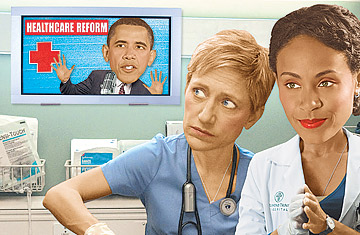
Illustration of Nurse Jackie.
On June 24, ABC debuted a controversial new medical drama: Barack Obama, M.D. Actually titled Questions for the President: Prescription for America, the town-hall forum sat the POTUS down to field questions about his plans to overhaul the health-care system. Before it aired, Republicans criticized it as an infomercial that would allow Obama to sell his platform to a vast prime-time audience.
That critique turned out to be off on two counts. The questions--from an audience including a former Bush Medicare official and the CEO of Aetna--focused mostly on the worries of the already insured about what would happen to their choice and coverage. More important, the special drew a mere 4.7 million viewers, barely half as many as NBC's earlier Inside the White House, in which Brian Williams ate burgers with the President and petted First Dog Bo.
In prime time, it seems, the medical issues that score with audiences are, Does Izzie survive? And will House hook up with Cuddy? As Obama rolls out his reform plans, the networks are rolling out a slew of new medical shows--which just may do more to shape views of medicine than Charlie Gibson ever could.
TV doctor series have long been enmeshed with politics. In the 1960s the American Medical Association--which was vehemently fighting Medicare--signed off on Dr. Kildare and Ben Casey scripts, seeking to promote a positive image of status quo medicine. (By the 1970s, doctors complained that Marcus Welby was too unrealistically wonderful.)
As HMOs spread and the ranks of the uninsured grew, however, TV handed out fewer lollipops to the medical profession. In 1994, at the peak of the Clinton health-care fight, NBC announced ER, on which overwhelmed County General hospital treated the underinsured masses who didn't have access to preventive medicine. As Anthony Edwards reminisced to the New York Times, "It was the beginning of the era when the emergency room became primary care."
There have been many doctor series since then--Scrubs, House, Grey's Anatomy. But several new medical shows focus instead on the nurses and paramedics who provide so much actual hands-on care in the age of overscheduled M.D.s. In these shows, saving patients is a chaotic, bureaucracy-plagued process--when it happens at all.
On Showtime's Nurse Jackie, Edie Falco's title character runs up against a hospital administration that wants to wring every possible dime out of patients. "All Saints [Hospital] is in the business of flipping beds," Jackie tells a colleague. "That's it. End of story. The fact that you have even the slightest inclination to help people puts you miles ahead of 100% of the population." (In real life, Falco is a health-care-reform activist.) Jada Pinkett Smith also plays an overworked nurse taking on bureaucracy, on TNT's Hawthorne. On NBC's fall drama Trauma (not to be confused with CBS's Miami Trauma), a supervisor warns a paramedic not to let a mother assist with her son's emergency tracheotomy: "It's a lawsuit waiting to happen!"