

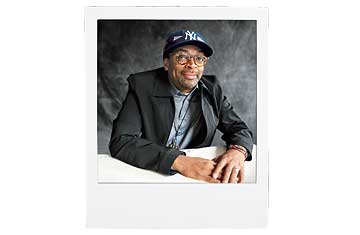
Spike Lee
What impact would you say that Do the Right Thing had on race relations in America? Aqeel Kameelah FORT LAUDERDALE, FLA.
Well, it didn't end it. [Laughs.] I don't know what film will be able to do that. I think maybe a better question might be, Can you still do films today dealing with race in the so-called, quote-unquote, postracial world we live in? I don't even know what that is when people say that. It would be a different movie, but I don't think that subject matter has been exhausted.
Do people still ask you why Mookie threw the garbage can through the window at the end of the movie? Jason Geller NEW YORK CITY
Not as much. It has died down somewhat after 20 years. What we wanted to do is to have people have serious discussions and debates about this subject which a lot of people feel uncomfortable about. That was the intent from the beginning.
How do you respond to young people, especially with the election of Barack Obama, who believe racism is not as significant as it was for older generations? Martin Zacharia, CHICAGO
It might not be as significant, but it still has significance. I will admit that younger people have different attitudes about race than their parents and grandparents, but race is still with us today, and it's going to be a while before it's totally eradicated. That's why I still have issues with this term postracial society, which is not the case at all.
Has there ever been a topic that you wanted to make into a movie but did not or could not because of certain cultural or financial constraints? Marie Fatil, MIAMI
The constraint has been money. It's always money. I wanted to do a biopic on Jackie Robinson. I want to do a biopic on Joe Louis and Max Schmeling. I want to do a biopic on James Brown. If Hollywood studios don't think that they're going to make money on it, they're not going to give you the money. Simple as that.
Are there any other African-American figures whose story you want to make into a movie? Taffany McElvine CHANDLER, ARIZ.
I would love to do one on Harriet Tubman. I think maybe one day a slave epic. Apart from Roots, which was on television, I don't think there's been a serious film dealing with slavery in this country. It would need alternative means of finance. It's not something that you could get made through the traditional Hollywood system.
Are you conscious of the doors you've opened for many African-American actors, and do you plan to continue to cast new faces in upcoming projects? Elise Woodson LOS ANGELES
Oh, yeah. What she's talking about didn't happen by accident. That was the plan, to give young, talented people--and not just black--a chance. And not just in front of the camera but behind the camera too. It's all part of a plan.
What has been your most challenging film to make? Nachi Kamatkar PITTSBURGH, PA.
Here goes two. The first one: She's Gotta Have It. The next one would be Malcolm X; the pressure was on Denzel [Washington, who played the title character] and me to do that. We didn't have a lot of money to do it.
How important to you are the critics' reviews of your films? Do you still look at them or care? Jeffrey N. Golub, SEATTLE