

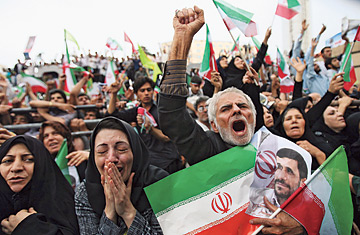
Supporters of the Iranian President gather in Tehran's Vali Asr Square to celebrate his re-election.
(2 of 5)
But even if the election campaign, in the end, proves meaningless, it provided a rare look at the divisions in Iranian society, and not just between the working-class Ahmadinejad supporters and the wealthier, better-educated backers of Mousavi. It also put the internal rivalries at the highest levels of the Iranian government on public display for the first time, and in the most embarrassing fashion.
The President was, without question, the best politician in the race. His debates against the two reformers, Mousavi and Mehdi Karroubi, were routs. Both challengers were exemplars of the older generation--the generation that made the Islamic revolution in 1979--and both were flummoxed by a candidate who seemed to have been trained by some Iranian equivalent of Karl Rove. They appeared paralyzed by what they considered his coarse impertinence; in American terms, these might have been debates between George Bush the Elder and Newt Gingrich, a gentlemanly establishmentarian against a rude populist brawler. Ahmadinejad was a slick combination of facts and accusations. He spoke directly into the camera. He deployed little charts, as Ross Perot did in the 1990s, to show that things weren't as bad as people thought. His statistics were heavily massaged and challenged by his opponents, but he had muddied his greatest vulnerability--the stagflating Iranian economy. The real jaw dropper, however, was Ahmadinejad's willingness to attack in the most personal terms. He attacked Mousavi for being supported by former President Ali Akbar Hashemi Rafsanjani, whom he flatly called corrupt (a widespread belief among reformers and conservatives alike); he attacked Mousavi's wife Zahra Rahnavard, a famous artist and activist, for allegedly getting into college without taking the entrance exam; he attacked Karroubi for taking money from a convicted scam artist.
The reformers--and even many of the more prominent conservatives (who call themselves principalists)--considered these attacks outrageous, outside the rules of Iranian politics. "The attacks might have worked with Ahmadinejad's supporters," said Amir Mohebbian, a prominent principalist thinker who backed Ahmadinejad with some reservations. "But they were not good for the system." Indeed, Ahmadinejad's toughest debate was with the other principalist candidate, Mohsen Rezaei, a former commander of the Revolutionary Guards, who challenged the President's inflationary tendency to spend money on direct wealth redistribution--all sorts of stipends for the working class and the poor--while neglecting a long-term investment strategy. Unlike the older reformers, Rezaei refuted the President's arguments effectively. He directly addressed the Iranian people: "You go to the store. You know the price of cheese ... The people know what the real story is."