

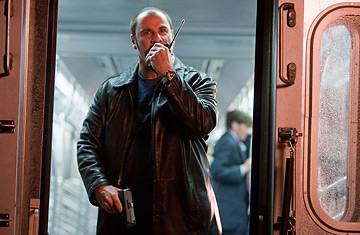
John Travolta stars in The Taking of Pelham 123.
New York City has provided the world with many disquieting visions over the years but few more surprising than the sight of Denzel Washington in The Taking of Pelham 1 2 3. Sitting at a subway dispatcher's console, the usually impeccable movie hero looks puffy and has a gut you could park a Hummer on. Weighing in at a sedentary 220 lb., he's playing a desk jockey burdened by the usual bureaucratic bull plus a scandal that has put his career in the commode. And now, on the other end of the line, he's got a chatty psychopath (John Travolta) who just hijacked a Pelham local and wants $10 million, cash, in an hour flat--or he'll commence killing his passenger-hostages, one a minute.
Directed by Tony Scott (Top Gun, Deja Vu) with his usual gusto and a few too many circling camera movements, this conventionally compelling movie is packed with reliable thriller ingredients: the criminal mastermind, the clock ticking toward certain doom, the runaway train, the ordinary man tapped for a suicidal mission. It's based on the John Godey novel and the 1974 film version, The Taking of Pelham One Two Three, with Walter Matthau as the transit cop and Robert Shaw as the hijacker. Both movies speak volumes about the state of the entertainment industry, then and now.
In the mid-'70s, near bankruptcy and a soaring murder rate had made New York City the poster child for urban dystopia, and Hollywood, which at the time was actually interested in reflecting contemporary society, turned out a raft of films--Serpico, Death Wish, Dog Day Afternoon, Taxi Driver--that navigated that stinky Styx. Pelham was one of those gritty exposés, and a tarnished time capsule of Gotham crime, sludge and cynicism. ("What the hell do they expect for their lousy 35¢?" a city employee says of the subway hostages. "To live forever?") Resilience too: Matthau is as wily as he is weary, and the passengers aren't so scared that they can't give a lot of lip back to their captors.
Today the subway fare is $2, and New York, which has the lowest crime rate of any large U.S. city, is the center of another national trauma: the financial crisis. In one sense, the new Pelham (written by Brian Helgeland, who won an Oscar for his L.A. Confidential script) has a stethoscope to that malaise when it alludes to the toxicity of insider trading. There's also a superrich mayor (James Gandolfini) who could be an outsize Michael Bloomberg. But most of the film takes place in a fantasy present, where the Dow is at 11,000--a relic of that halcyon era, i.e., last year, when the movie was shot. And a congestion of cars, arranged as carefully as clusters of Rockettes, isn't traffic; it's just the backdrop for a spectacular crash.
Washington's constricted calm is a smart contrast to the manic Travolta, who's channeling his strutting killer from Face/Off. If you're going to remake a '70s movie, it might as well be Pelham, an action film where the tension is conveyed mainly in phone calls, and it ought to work as efficiently as this one. But wouldn't it be nice, once in a while, for Hollywood to turn contemporary traumas into vigorous movies instead of hijacking the anxieties of the past?