

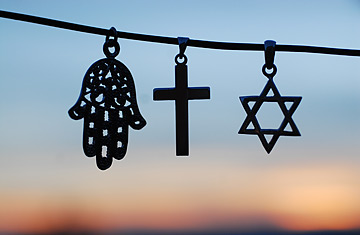
Symbols of the three Monotheistic religions.
(3 of 3)
A more inclusive view is also found in a biblical author (or authors) thought by many scholars to be writing shortly after the exile — the priestly source. The priestly source, or P, uses internationally communal language and writes not just of God's covenant with Israel but of an "everlasting covenant between God and every living creature of all flesh that is on the earth."
A zero-sum, isolationist worldview had moved Israel from polytheism to belligerent monotheism, but now, as Israel's environment grew less threatening, belligerence was turning out not to be an intrinsic part of monotheism. Between second Isaiah's angry exilic exclamations and P's more congenial voice, Israel had segued from an exclusive to an inclusive monotheism.
A millennium later, this same dynamic — swings between zero-sum and non-zero-sum — would have a similar impact on Islamic monotheism, moving it back and forth between belligerence and tolerance.
Muhammad's preaching career started in Mecca around 613 C.E., and he seems to have had hopes of drawing Jews and Christians into a common faith. In the Koran — which Muslims consider the word of God as spoken by Muhammad — the Prophet's followers are told to say to fellow Abrahamics, "Our God and your God is one."
This hope of playing a win-win game shows up in overtures to Jews in particular, made mainly after Muhammad moved to the city of Medina and became its political and religious leader. Muhammad decided his followers should have an annual 24-hour fast, as Jews did on Yom Kippur. He even called it Yom Kippur — at least he used the term some Arabian Jews were using for Yom Kippur. The Jewish ban on eating pork was mirrored in a Muslim ban. Muhammad also told his followers to pray facing Jerusalem. He said God, in his "prescience," chose "the children of Israel ... above all peoples."
As for Christians: having denounced polytheists who believed Allah had daughters, Muhammad couldn't now embrace the idea that Jesus was God's son. But he came close. He said Jesus was "the Messiah ... the Messenger of God, and His Word ... a Spirit from Him." God, according to the Koran, gave Jesus the Gospel and "put into the hearts of those who followed him kindness and compassion."
Muhammad's ecumenical mission seems to have failed. Certainly, he sensed rejection from Christians and Jews. A Koranic verse captures his disillusionment. "O Believers! Take not the Jews or Christians as friends. They are but one another's friends." Once you're convinced that non-zero-sum collaboration isn't in the cards, the bonhomie dries up.
In his new, zero-sum mode, Muhammad changed the direction of prayer from Jerusalem to Mecca. According to Islamic tradition, he expelled three tribes of Jews from Medina — and killed the adult males in the third tribe, which was suspected of collaborating with Meccans in a battle against Medina.
Still, in the end, Christians and Jews get a favored place in Islamic tradition as "people of the Book." The Koran repeatedly says they're eligible for salvation.
Within years of Muhammad's death in 632, Islamic leaders started conquering lands far and wide. This imperial expansion gave birth to the doctrine of jihad, which mandates battle against unbelievers with the aim of conversion.
But once the conquering was done, Muslim leaders found that trying to compel uniform belief in a multinational empire was a lose-lose game. Doctrines granting freedom of worship to Christians and Jews emerged promptly. And later, such freedom would also be granted to Buddhists and polytheists.
Meanwhile, the doctrine of jihad would be dulled through amendment. And the notion of a "greater jihad" — struggle within oneself toward goodness — would arise and be attributed to Muhammad himself. As in Israel after the exile, the Abrahamic God, having found himself in a multiethnic milieu rife with non-zero-sumness, underwent moral growth.
In neither case had the growth been smoothly progressive, and in both cases, there would be backsliding. Still, in both cases, God spent enough time in benevolent mode to leave the Scriptures littered with odes to tolerance and understanding, verses that modern believers can focus on, should they choose.
Will they so choose? Maybe the code embedded in the Scriptures can help. The key, it suggests, is to arrange things so that relations between Muslims and Jews are conspicuously non-zero-sum.
Sometimes this may mean engineering the non-zero-sumness — for example, strengthening commerce between Israel and the Palestinian territories. Other times it will mean highlighting a non-zero-sum dynamic that already exists — emphasizing, for example, that continued strife between Israelis and Palestinians will be lose-lose (as would escalated tensions between the "Muslim world" and the "West" more broadly). Enduring peace would be win-win.
This peace would also have been foretold. Isaiah (first Isaiah, not the Isaiah of the exile) envisioned a day when God "shall arbitrate for many peoples" and "nation shall not lift up sword against nation, neither shall they learn war any more." And in a Koranic verse dated by scholars to the final years of Muhammad's life, God tells humankind that he has "made you into nations and tribes, so that you might come to know one another."
This happy ending is hardly assured. It can take time for people, having seen that they are playing a non-zero-sum game, to adjust their attitudes accordingly. And this adaptation may never happen if barriers of mistrust persist.
But at least we can quit talking as if this adaptation were impossible — as if intolerance and violence were inevitable offshoots of monotheism. At least we can quit asking whether Islam — or Judaism or any other religion — is a religion of peace. The answer is no. And yes. It says so in the Bible, and in the Koran.