

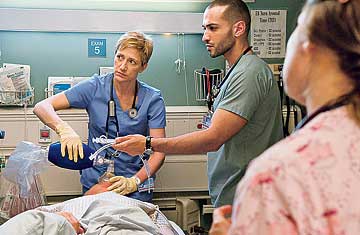
Jackie, Falco, left, focuses on the taxing physical work of nursing.
For the first few seconds of Nurse Jackie (Showtime, Mondays, 10:30 p.m. E.T.), you might believe you are staring into heaven. Everything is white — the glaring light, the ceiling, the walls. Then the camera pans down to a figure on the floor, dressed to match in blinding hospital whites. The only colors in the scene are a pink blotch of gum on the worn sole of her shoe and an amber prescription bottle — holding the Vicodin capsules that, we learn, she cracks open to snort the brilliant orange grains inside, medicating a bad back and her emotional state.
If Jackie Peyton (Edie Falco) is an angel of mercy, we quickly learn that she is, in more ways than one, a fallen one. And she is one of the most interesting people you're likely to meet on TV this year.
Nurse Jackie is getting the jump on a TV calendar heavy with new medical shows. (Hawthorne, with Jada Pinkett Smith as a nurse, debuts on TNT on June 16.) But this black comedy is less melodramatic than your typical prime-time IV drip. Nursing, as Jackie practices it at New York City's All Saints Hospital, is hard labor: taxing drudgery that ruins your back and gets you punched out by the occasional unhinged visitor. (See pictures of ER's long run on television.)
It also saves lives — sometimes in spite of the efforts of doctors, who, in Nurse Jackie, are at worst arrogant and obtuse, at best brilliant but detached. Her best friend, surgeon Eleanor O'Hara (Eve Best), lays out the differences in their mind-sets: Jackie, she says, became a nurse because she wanted to help people. "When I was a little girl," Eleanor says, "I took a butter knife and opened up a dead bunny to see how it worked. That's why I'm a doctor."
Nurse Jackie has a fine-grained sense of hospitals' feudal hierarchy, but it's ultimately about the paradox of Jackie: she's dedicated and moral in her professional life but — in ways it's better not to spoil — hurtful in her private life. As when Falco portrayed Carmela Soprano, she plays tough while letting her emotions spark from every nerve, and she shows a gift for tart comedy here too. To get her job done, Jackie needs to be part nurturer, part con artist, part stand-up comic. "What do you call a nurse with a bad back?" she asks in a voice-over. "Unemployed! Ba-dum-bum!"
Some of the supporting characters need work (especially a too sitcommy administrator played by Anna Deavere Smith), and some patients-of-the-week veer into clichés. But Falco is outstanding as a living reminder that you meet angels only in the next life. It takes a flawed, sloppy human to keep you in this one.