

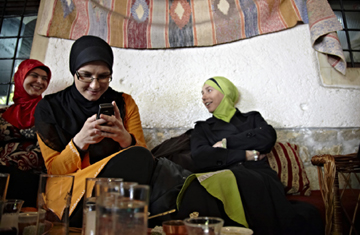
JOY IN MODESTY: Devout Muslims such as Husic, right, and her friends are changing Sarajevo's face
(2 of 2)
Indeed, for many Bosnians the religious awakening simply enriches the old city, restoring a taste of Islamic traditions rooted in more than four centuries of Ottoman rule. Yet Western and Bosnian intelligence agencies tell Time they are nonetheless concerned by a small group of local Muslim militants, who they say could have more sinister plans. That's led to a series of arrests. Rijad Rustempasic, 34, was raised in a small town in Bosnia and now lives in Sarajevo's old town. During the war he converted to Salafi Islam, a rigidly conservative branch of the religion, and joined a unit composed mostly of Arab foreign fighters, between 500 and 1,500 of whom had gone to Bosnia to support their fellow Muslims. Rustempasic says he has been arrested six times since Sept. 11, 2001. "It's always the same scenario," he says, sporting a long russet beard and a ponytail, while his wife wears a full black chador. "The police barge into the house early in the morning and accuse me of having al-Qaeda connections." Last year police netted a cache of antitank mines in Rustempasic's family house, and imprisoned him for two months; Rustempasic and three others were arrested on suspicion of involvement in terrorist activities, but they were released due to a lack of evidence. Rustempasic says the weaponry was wartime trash from the 1990s, and claims he is being hounded for his Salafi beliefs. Still, his talk is disquieting. "There is a religious thought that Muslims are one body," he says. "As far as I know no Bosnian has been captured in Iraq or Afghanistan, but it is always within the domain of possibilities."
In 2005, a police raid found more damaging evidence after raiding another Salafist group in Sarajevo. In one apartment the cops found about 44 lb. (20 kg) of explosives, and a training video of how to construct suicide-bomb belts. In Sarajevo I met Bajro Ikanovic, 32, one of the four men arrested for plotting terrorist attacks as a result of that raid. Sitting in a café during a four-day furlough from prison, he told me he has converted several young men to militant Islam, and has pressed them to consider fighting to defend their religion. "Muslims who do not preach jihad are cowards, or just too comfortable with their lives," he says. Asked if young militants should fight in the Afghanistan or Iraq wars, he says, "Why not? If my Muslim brother is fighting in Pakistan, his enemy is my enemy." Still, he says, "we need fighters more here than there."
Intelligence officers dismiss such fiery talk as bluster, saying it would be difficult to conceal a terrorist plot in a country as small as Bosnia. "Word spreads fast," says Aner Hadzimahmutovic, antiterrorism chief at the State Investigation and Protection Agency. "If 15 people with beards meet in the bush, someone will report them to us." The one Bosnian who repeatedly claims to have trained and fought with al-Qaeda in Afghanistan — citing gory details of how he supposedly slit the throat of an Australian soldier — remains free. Nihad Cosic was arrested in a 2007 police raid in Pakistan, but released for lack of evidence and flown home to Sarajevo. In April he offered his most recent description of his years fighting with al-Qaeda to Austrian and German journalists visiting Sarajevo. Yet Bosnian police have not sought to arrest him for terrorism, and last year an intelligence official told a Sarajevo publication that Cosic posed no threat to Bosnia and had dropped "very low on the list of priorities."
For Bosnia's antiterrorist chief Hadzimahmutovic, the idea of a homegrown Islamic threat is a fabrication of Serb politicians. Washington is less certain. The U.S. State Department's Country Reports on Terrorism 2008, released on April 30, says competing intelligence agencies in Bosnia are failing to share information. As a result, the report states, Bosnia is "vulnerable to exploitation as a potential staging ground for terrorist operations in Europe."
By and large, in Sarajevo that potential still seems remote. The city's residents remain wary of militants. Rustempasic says he doubts any company will ever employ him, and when three Algerian-born Bosnian citizens returned to Sarajevo after six years' detention in Guantánamo, they were shunned by those who feared they would spread militant Islam. "They have no opportunity to get jobs," says human-rights activist Dizdarevic. More typical of Sarajevo's new religious fervor are young professionals like Begic and Husic, whose faith has instilled meaning and order into their once tumultuous lives. Husic says she has learned to ignore the jeers that her head scarf attracts in Catholic neighborhoods. And Begic says her next movie, titled Bait, tackles growing prejudice, including against women in hijab. "They think we are backward," says Begic bitterly. "It is racist." For her war-weary generation, another era of murderous discord is an unbearable prospect.