

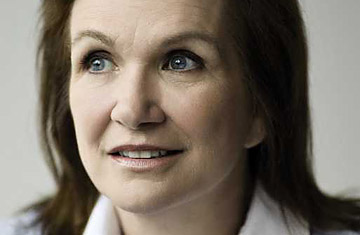
Elizabeth Edwards
(3 of 6)
And I suppose like most wives--or husbands--in my position, I wanted to believe his involvement with this woman had been as little as possible. A single night, another opportunity, but that was it, and he had wanted away from her. I hung on to whatever I could. I was, in nearly every sense, Tecmessa or the wife of any soldier or warrior who comes back from a campaign changed: I wanted my old life back with the man I knew and loved. I looked at his face and heard his voice, and it seemed possible, didn't it, that nothing had really changed. The man I married couldn't have done this. No matter how much I wanted it to be otherwise, like those women, I had to accept that the man who had come home to me was different and that our story would be different because of that. But knowing that and letting go of my expectations were two quite different things.
I spent months learning to live with a single incidence of infidelity. And I would like to say that a single incidence is easy to overcome, but it is not. I am who I am. I am imperfect in a million ways, but I always thought I was the kind of woman, the kind of wife to whom a husband would be faithful. I had asked for fidelity, begged for it, really, when we married. I never need flowers or jewelry; I don't care about vacations or a nice car. But I need you to be faithful. Leave me, if you must, but be faithful to me if you are with me.
It wasn't a premonition. I was talking about my own history. At 13 I had read my mother's journals, found them buried beneath a mattress in a guest room. I discovered that my mother believed my father had been unfaithful to her when I was a baby. I will say clearly that I do not know if that is true. I only know what she suspected. She was serially pregnant in the late 1940s and early 1950s: My brother was born 13 months after I was; my sister was born 12 months later. And my mother believed, rightly or wrongly, that my father had found other companionship while she was buried in babies. She even thought she knew where--the Willard Hotel in Washington--the place I had my senior prom, which must have been a bitter pill for her, although I had a suitably terrible time because, unbeknownst to her, I knew what that hotel meant to her.
There was never a satisfactory place to settle, so she lived all those decades still loving him, but with something deep inside her that would always be restless, even after he died. "The trust was supposed to be deep. The smiles were supposed to last forever." Don't ever put me in that position, I begged John when we were newlyweds. Leave me, if you must, but do not be unfaithful.
The possibility of my father's infidelity ate at Mother, I knew, but she stayed there, stayed with him and loved him, and after his stroke when he was nearly 70, she cared for him for nearly two decades with a selflessness that is almost unimaginable. Was that what I was supposed to do? And I was the one who would need the care. Although we did not know yet at the beginning of 2007 that the cancer had metastasized, we did know since 2005 that the cancer had spread at least to my lymph nodes, that there was some possibility of metastasis. I was the one who would need the selfless partner.