

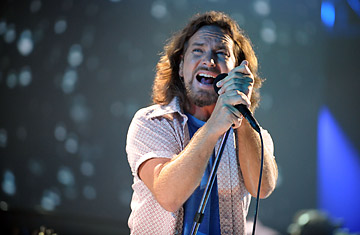
Singer Eddie Vedder of 'Pearl Jam.'
How many times will you buy a record you love? The logical answer is once, since CDs and MP3s are all but indestructible, but logic has never had much to do with love or the record business. This year in particular, the industry is banking on the absence of logic. Scan a list of 2009's major releases and you'll discover almost as many reissues — repackaged classics with improved sound or added tracks — as originals. You may not be tempted by Lenny Kravitz's Let Love Rule 20th Anniversary Deluxe Edition or Average White Band's re-pressed Cut the Cake — generally you have to want something once before wanting it twice. But in May, Universal will begin reissuing the Rolling Stones' 14 most recent albums, while in September, EMI and Apple Corps will reissue all 12 of the Beatles' studio albums. By October, logic be damned, many baby boomers will be a few hundred dollars lighter.
The relationship between record companies and reissue buyers has not historically been built on good faith. Anyone who owns one of the nine versions of the Beach Boys' Pet Sounds, each with its own seductive "extra" features, knows it's a lot more like the relationship between Charlie Brown and Lucy. But after years of selling slightly improved old goods at steep new prices, at least a few labels have started focusing on quality control. "In this day and age and economy, we have to make something remarkable, or we're not going to be able to compete," says Adam Block, general manager of Legacy Recordings, Sony's catalog and archive arm. "We have to start with a great record and then figure out how to make the experience even greater." (See the top 10 comeback albums.)
Boomers are fish in a barrel for improved nostalgia, but Gen X isn't far behind. In early April, Sony reissued four physical editions of Pearl Jam's 1992 album Ten at four price points. Each offered improved sound, a separate remix album, a DVD and thoughtful, creative packaging born of collaboration with the band. (A digital version without the extras is also available.) More important, Block's team reached out to Pearl Jam's fans and asked specific questions about what they wanted. In their first week of release, the various Tens combined to sell 55,000 copies — including an astonishing 10,000 of the $199 collector's edition. "People don't love music any less today than they ever have," says Block, who also oversaw last year's well-received $109.98 Miles Davis: Kind of Blue: 50th Anniversary Collector's Edition. "The right presentation still gets a response."
So does the right selection. Most reissues are by acts with rabid fan bases (U2 put out a souped-up version of The Joshua Tree last year; Bruce Springsteen recently announced plans for a new Darkness on the Edge of Town) that have both cash and nostalgia in abundance. Rap? Not many reissues. The Grateful Dead? Too many to count. Older bands fare better for technological reasons; advances in transferring music from analog to digital mean that most records from the '70s and '80s sound demonstrably better, even to amateur ears. "That's a big selling point," says Adam Yauch of the Beastie Boys, who are in the midst of reissuing three of their early albums. "People who care about sound really care. Our records were too tinny and didn't have enough low end. We've fixed that."
The true test of the reissue market's strength and revenue-generating power will come in September. The Beatles' albums haven't been touched since their original transfer to CD in 1987. Early word is that the remastered records sound great, though because of disagreements with Apple, they probably won't be available on iTunes, and the extras — mostly making-of documentaries — are a little underwhelming. They'll probably sell anyway, but if the Beatles and EMI are feeling just, they'll remember that the money they take from reissues is equal to the love they make them with.