

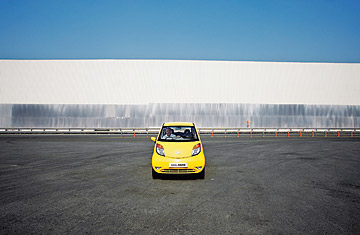
Tata hopes to sell the Nano in Europe and the U.S. in just a few years.
(2 of 2)
In the near term, the Nano will have little effect on Tata Motors' revenue, adding just 3% to sales, analysts estimate. It will have even less impact on the company's ailing bottom line, because the Nano's profit margin is tiny, says Vaishali Jajoo, a senior automotive-research analyst at Angel Broking, an investment firm in Mumbai. "It will take at least four to five years to break even" and recoup the company's development costs, she says. There's more profit to be made from fully equipped Nanos with air-conditioning, power windows and upholstered seats, which cost about $3,300. "How they're really going to make money is by selling the high-end version," says Tilak Swarup, general manager of SupplierBusiness India, whose team of analysts tracks suppliers to the global auto industry. But the company has not yet decided how many high-end versions to produce.
Nor is the rollout plan for the rest of the world set. Tata Motors sells cars, trucks and buses in 16 countries in Europe, Africa, the Middle East, South America and South Asia. For now, the company only has firm plans to export the Nano to Europe starting in 2011. While the possibility of selling Nanos in the SUV-loving U.S. were once considered remote, Tata executives now say the recession is changing the buying habits of American consumers, offering an opening for economical vehicles. They have plans to develop a Nano for the U.S. in the next three years.
Tata Troubles
While the company seeks to redefine the low end of the market, Tata Motors is struggling with its attempt to gate-crash the luxury-car segment. Last year, the Indian carmaker made auto-industry waves when it spent $2.3 billion to buy Ford Motor's lossmaking Jaguar and Land Rover (JLR) business. Since then, demand for luxury vehicles has tanked, sales of Tata Motors other models have softened, and the company faces a looming deadline to refinance $2 billion in loans for the JLR deal. "That's a major cash-flow crunch for them," Jajoo says. The company is pursuing several options: floating shares of Tata Motors, rolling over the JLR loan at a higher interest rate, and getting a bailout for JLR from the British government. "Tata Motors is progressing on the refinancing options and discussing with banks," a spokesman said. It can also tap funding from stronger sisters within the Tata Group, which controls 98 companies in sectors ranging from steel to technology services. But "the whole group is under major debt," says Swarup of SupplierBusiness India.
Nano sales won't do much in the short run to ease the burden. But Tata Motors' efforts to pioneer cost-saving business processes during the Nano's development could translate into a healthier bottom line down the road. One of these innovations is "distributed manufacturing." Instead of investing in expensive factories and hiring additional workers as sales volumes increase, Tata Motors plans to limit Nano production at its central plant to 500,000 cars every year. Beyond that, it will use satellite plants to build the car's components and distribute these in Nano "kits" to independent entrepreneurs — trained and monitored by Tata Motors — for final assembly and distribution. "They will become our dealers," Ratan Tata explains. He hopes the Nano will push the auto industry toward fully outsourced manufacturing, leaving car companies to focus on design and marketing — a structure similar to that used in the highly competitive computer industry, where companies such as Apple create products but subcontract the actual manufacturing to specialists operating factories in China and other countries where labor costs are relatively low. "What I tried to describe on the Nano is an attempt to look at [outsourcing] as a business model," Tata says.
This bold idea may take years to realize, but the Nano is a first step. Tata hopes the car's launch will encourage similar innovations throughout the Tata Group. Others envision the Nano as something even more: a way to connect and mobilize India's declining rural economy, creating new jobs, new infrastructure and a culture of innovation far outside the big cities. "It's kind of like the iPod," says Tarun Khanna, a Harvard Business School professor who has studied the Tata Group for years. The Nano is a blank slate, he explains, that makes people think, What can you do with it? What if auto-rickshaw drivers bought Nanos, for example, and used them as more profitable, safer taxis? Or if farmers used them to bring their goods to market more quickly?
In an unhappier scenario, the Nano ends up not as a tool to empower the rural poor but as another urban burden. If middle-class mobility comes to millions of people in the developing world, their shiny new Nanos could greatly add to traffic congestion and air pollution in major cities. Tata doesn't see it that way, calling complaints about the potential environmental impact of widespread Nano adoption "somewhat ironic." "It's almost like a car is O.K. for some people, but don't spread it to the larger base of the population," he says. "Why are we denying the masses comforts that we enjoy today?" There are millions of other families still in India, still piled onto motorcycles, who have asked themselves that question. "It's difficult to carry my entire family on a bike," says Jyotirmoy Sarkar, a rice farmer in a village 72 miles (116 km) from Kolkata. "For people like me with limited means but big dreams, Nano is a dream come true." That's a big order for a small car.
— with reporting by Nilanjana Bhowmick / New Delhi
See the history of the electric car.