

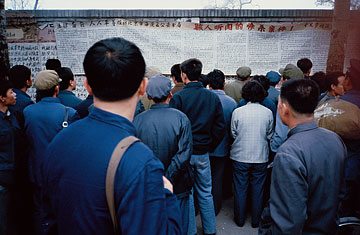
Dashed hopes: Beijing's Democracy Wall, 1979
In March 1979, in a provincial Chinese town named Muddy River, a 28-year-old counterrevolutionary, Gu Shan, is executed, after 10 years of imprisonment, for publicly losing her faith in communism. At the denunciation ceremony, which the entire town is obliged to attend, it becomes clear that her vocal cords have been severed so that she cannot cry out counterrevolutionary slogans. But like a stone cast in water, the ripples of this execution spread out wide and The Vagrants — Yiyun Li's first novel after her extravagantly praised and miraculously poised prizewinning debut collection, A Thousand Years of Good Prayers — anatomizes with both precision and humanity all those touched by Shan's death.
Chief among them are Shan's parents, Mrs. Gu, devastated by her loss, and Teacher Gu, bewildered by the nature and personality of the child he has fathered and retreating further into the arid haven of his intellect in order to cope with her demise. But there are less obvious people the death marks: Kai, a public announcer on a government radio station that spews out continuous propaganda; Kai's husband Han, a man on the make in the provincial government, who harbors dreams of greater influence; and Nini, a deformed girl, eldest of six daughters, who is nothing more than an unpaid, unloved servant to her family.
As Li reveals the lines of connection — some hidden, some potential, some accidental — between these lives and gives each of them vast, rich interiorities, news reaches Muddy River of Beijing's Democracy Wall movement (in which reformists posted calls for political change on a wall in the city center). It is followed by more shocking news: just before her execution, Shan's kidneys had been harvested for an influential Communist Party official who needed them. A fledgling protest haltingly tries to gather momentum in Muddy River — but when the democratic movement in Beijing is suppressed, Muddy River's hopes of change are also routed brutally.
Based on a true story, The Vagrants is a bleak masterpiece, written without sentimentality, its anger a cold, controlled fury rather than a shrill rage. The surface of its unshowy prose disguises an enormous achievement for the realist political novel. Li's relentless calibration of the cost paid by the innocent to sustain a dehumanizing and brutal sociopolitical order marks it as a milestone in the literature of oppressed, extinguished lives.