

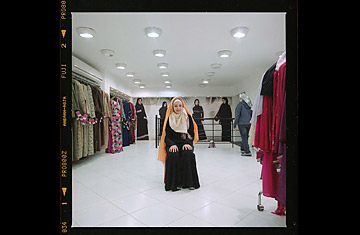
At a store in Cairo, an assistant places a white scarf of nontransparent material directly on the head of another assistant, ensuring that all of the hair is concealed.
(2 of 4)
Text-Messaging The Koran
The soft revolution is made concrete in hundreds of new schools from Turkey to Pakistan. Its themes echo in Palestinian hip-hop, Egyptian Facebook pages and the flurry of Koranic verses text-messaged between students. It is reflected in Bosnian streets honoring Muslim heroes and central Asian girls named after the holy city of Medina. Its role models are portrayed by action figures, each with one of the 99 attributes of God, in Kuwaiti comic books. It has even changed slang. Young Egyptians often now answer the telephone by saying "Salaam alaikum"--"Peace be upon you"--instead of "Hello." Many add the tagline "bi izn Allah"--"if God permits"--when discussing everything from the weather to politics. "They think they're getting a bonus with God," muses Ziada.
Even in Saudi Arabia, the most rigid Muslim state, the soft revolution is transforming public discourse. Consider Ahmad al-Shugairi, who worked in his family business until a friend recruited him in 2002 for a television program called Yallah Shabab (Hey, Young People). Al-Shugairi ended up as the host. Although he never had formal religious training, al-Shugairi quickly became one of the most popular TV preachers, broadcast by satellite to an audience across the Middle East and watched on YouTube. "The show explained that you could be a good Muslim and yet enjoy life," says Kaswara al-Khatib, a former producer of Yallah Shabab. "It used to be that you could be either devout or liberal, with no middle ground. The focus had been only on God's punishment. We focused on God's mercy."
In 2005, al-Shugairi began a TV series called Thoughts during the holy month of Ramadan, focusing on the practical problems of contemporary Muslim life, from cleanliness to charity. Sometimes clad in jeans and at other times a white Saudi robe and headdress, he often speaks informally from a couch. "I'm not reinventing the wheel or the faith," al-Shugairi explains in Jidda's Andalus Café, which he opened for the young. "But there is a need for someone to talk common sense." (See pictures of Ramadan.)
Al-Shugairi's own life mirrors the experimentation and evolution of many young Muslims. In the 1990s, he says, he bounced from "extreme pleasure" as a college student in California to "extreme belief." The shock of Sept. 11, an attack whose perpetrators were mostly Saudi, steered him to the middle.
Traditional clerics deride al-Shugairi, 35, and other televangelists for preaching "easy Islam," "yuppie Islam," even "Western Islam." But his message actually reflects a deepening conservatism in the Islamic world, even as activists use contemporary examples and modern technology to make their case. One of al-Shugairi's programs on happiness focused on Elvis Presley, a man with fame, talent and fortune but who died young. Life without deep spirituality, al-Shugairi preaches, is empty.
The soft revolution's voices are widening the Islamic political spectrum. Mostafa Nagar, 28, an Egyptian dentist, runs a blog called Waves in the Sea of Change, which is part of an Internet-based call for a renaissance in Islamic thinking. Yet Nagar belongs to the Muslim Brotherhood, the largest Islamist movement in the Middle East. His blog launched a wave of challenges from within the Brotherhood to its proposed manifesto, which limits the political rights of women and Christians. Nagar called for dividing the religious and political wings of the movement, a nod to the separation of mosque and state, and pressed the party to run technocrats rather than clerics for positions of party leadership and public office.
When Nagar and his colleagues were urged to leave the Brotherhood, they decided to stay. "As a public party," he says, "its decisions are relevant to the destiny of all Egyptians, so their thoughts should be open to all people." And indeed, his blog--and other criticism from the movement's youth wing--has caused the manifesto to be put on ice.