

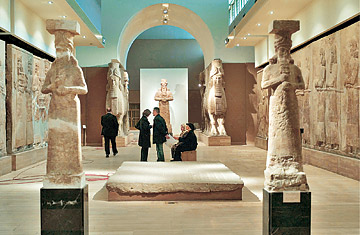
A gallery of Assyrian statues and friezes at the Iraqi National Museum.
Nobody at the Iraqi National Museum in Baghdad knows exactly how the stolen Sumerian tablets ended up in Peru. All that authorities in Lima could tell museum officials was that the three hand-size objects, more than 2,000 years old, were seized roughly a year ago from the luggage of an American traveling in the country. "I'm not involved in the other details," says Amira Edan, who heads the museum's efforts to reclaim lost artifacts and who flew to Peru to retrieve the tablets. "What was important for me was to take the items back." And take them he did: the tablets were returned to Baghdad in time for the Feb. 23 reopening of the National Museum, which had been shuttered to general visitors for almost six years.
In the chaos surrounding the collapse of Saddam Hussein's regime in the spring of 2003, thieves ransacked the vast collection of Stone Age, Assyrian, Babylonian and Islamic artifacts exhibited at this sprawling complex of nondescript buildings in central Baghdad. And while many of the huge stone carvings of Iraq's ancient rulers were simply too heavy for looters, other items in the museum's collection--once the world's largest store of Mesopotamian artifacts--are pocket-size. An estimated 15,000 of them vanished in a matter of days before U.S. troops took control of the museum. For many Iraqis, the loss of their cultural treasures was an omen of what lay ahead under U.S. occupation, and the shuttered museum stood as a symbol of Iraq's troubles through the years of violence that followed.
Inside, priceless artifacts sat scattered throughout darkened halls, resting largely forgotten among cardboard boxes and broken office chairs. But quietly, museum workers began refurbishing the exhibition halls and organizing the remaining collection. And officials like Edan launched what became a years-long quest to recover thousands of items taken from the museum and from scores of unprotected archaeological sites around Iraq. Gradually, daggers, necklaces, small statues and bits of pottery began to find their way back onto museum shelves. By 2008, items were streaming in by the hundreds, thanks to cooperation between the new Iraqi government and international authorities.
Most recovered artifacts have come from just across the border--2,500 from Jordan and more than 760 from Syria. And while Peru appears to be the farthest that purloined Iraqi treasures have traveled, items have also been discovered in Italy and the U.S. Edan estimates that authorities have retrieved as many as 17,000 artifacts stolen from unprotected historic sites and 4,700 pieces taken from the museum during the chaos of 2003.
Security is tight at the museum these days. It's the archaeological sites that are increasingly a concern. The tablets found in Peru, for example, were apparently stolen from an ancient Sumerian settlement south of Baghdad. For the first time, efforts are under way to form a special police task force dedicated to protecting Iraq's more than 8,000 archaeologically significant sites, including over 600 in Baghdad alone. Museum officials expect to see the first officers on duty in the coming weeks. About 400 will initially be assigned to guard various spots around Baghdad, and the force is eventually supposed to number as many as 10,000 officers across Iraq.