

(4 of 5)
"You find yourself having to take a chance," says Noah, who continues to eat his favorite brand of pretzels even though it now carries the warning "Produced in a facility that handles peanut butter." And he's not alone. A study by Sicherer in 2007 found that 75% of food-allergic people ignored these labels when shopping, unsure exactly how great the danger of cross-contamination was. The same study also found that 1 in 10 products tested actually contained the allergen noted in the warning on the packaging.
In an effort to make food labels more useful, the Food and Drug Administration is considering a new standard that would give consumers a better sense of how much cross-contamination may have actually occurred. After holding hearings on these advisory labels last fall, the agency is now studying systems like Australia's VITAL program, in which companies voluntarily rank the risk of cross-contamination on a scale of low to moderate to high. Meanwhile, Massachusetts last year became the first state to pass legislation requiring training for restaurant staff in safe food-allergy practices to avoid cross-contamination in the kitchen. (Read "Fighting over Peanuts.")
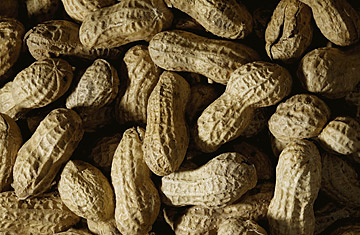
But until more rigorous standards are in place, eating continues to be a game of Russian roulette for the food-allergic. Which is why some researchers are trying to find a better way to treat allergies than simply advising their patients to avoid certain foods. In a new strategy called oral immunotherapy, doctors try to retrain the immune system by hitting it with the offending protein enough times, in increasing doses, that the body's defenses eventually relent and accept the protein as friend rather than foe. "It's the first generation of treatment that would make people less or even no longer allergic," says Dr. Wesley Burks, chief of pediatric allergy and immunology at Duke University Medical Center. On average, children treated this way for a year are able to tolerate the protein equivalent of 15 peanuts, while the untreated group developed allergic reactions after 1 ½ peanuts. For parents, allowing their kids to participate in the study was a leap of faith. "Doing this was the lesser of two evils," says Kimberly Carter, a Virginia resident whose daughter Hannah, 5, received a peanut-allergy diagnosis at a year old. "I was sure that at some point in her life, she was going to ingest peanuts, and there was a good chance she was going to die." Hannah recently had no adverse reaction after she downed chocolate pudding mixed with 5,000 mg of peanut protein — the equivalent of a dozen peanuts.
Hannah is now on a one-month reprieve from her daily pudding treatments; in four weeks, she will be challenged again with the same 5,000-mg dose of peanut flour. If she does not have a reaction, Burks will deem her "peanut tolerant" and allergy-free. If that happens, she will be among the first generation to conquer a food allergy. And perhaps it will be this scientific success that will provide the ultimate antidote to the hype and hyperbole. "We want people to understand what they have to do in case of an allergic reaction, but we don't want them to be so scared that they totally shelter allergic children, because that is not realistic," says Sampson. "It's a hard line to walk."