

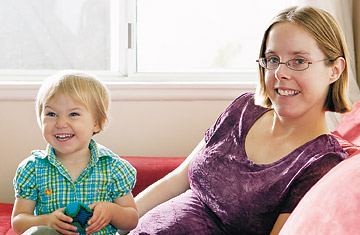
To avoid another C-section, Barton has to drive 100 miles to deliver in Los Angeles.
(2 of 2)
But many interpreted the revision to mean that surgical staff must be present the entire time a VBAC patient is in labor. While major medical centers and hospitals with residents are staffed to provide this level of round-the-clock care, smaller hospitals typically rely on anesthesiologists on call. Among obstetricians, many solo practitioners are unable to stay for what could end up being a 24-hour delivery; others calculate the loss of unseen patients during that time and instead opt to do hour-long cesareans, which are now the most commonly performed surgeries on women in the U.S.
Some doctors, however, argue that any facility ill equipped for VBACs shouldn't do labor and delivery at all. "How can a hospital say it can handle an emergency C-section due to fetal distress yet not be able to do a VBAC?" asks Dr. Mark Landon, a maternal-fetal-medicine specialist at the Ohio State University Medical Center and lead investigator of the NIH's largest prospective VBAC study. (See 9 kid foods to avoid.)
Part of the answer has to do with malpractice insurance. Following a few major lawsuits stemming from VBAC cases, many insurers started jacking up the price of malpractice coverage for ob-gyns who perform such births. In a 2006 ACOG survey of 10,659 ob-gyns nationwide, 26% said they had given up on VBACs because insurance was unaffordable or unavailable; 33% said they had dropped VBACs out of fear of litigation. "It's a numbers thing," says Dr. Shelley Binkley, an ob-gyn in private practice in Colorado Springs who stopped offering VBACs in 2003. "You don't get sued for doing a C-section. You get sued for not doing a C-section."
Of course, the alternative to a VBAC isn't risk-free either. With each repeat cesarean, a mother's risk of heavy bleeding, infection and infertility, among other complications, goes up. Perhaps most alarming, repeat C-sections increase a woman's chances of developing life-threatening placental abnormalities that can cause hemorrhaging during childbirth. The rate of placenta accreta--in which the placenta attaches abnormally to the uterine wall--has increased thirtyfold in the past 30 years. "The problem is only beginning to mushroom," says ACOG's Zelop.
"The decline in VBACs is driven both by patient preference and by provider preference," says Dr. Hyagriv Simhan, medical director of the maternal-fetal-medicine department of Magee-Womens Hospital of the University of Pittsburgh Medical Center. But while many obstetricians say fewer patients are requesting VBACs, others counter that the medical profession has been too discouraging of them. Dr. Stuart Fischbein, an ob-gyn whose Camarillo, Calif., hospital won't allow the procedure, is concerned that women are getting "skewed" information about the risks of a VBAC "that leads them down the path that the doctor or hospital wants them to follow, as opposed to medical information that helps them make the best decision." According to a nationwide survey by Childbirth Connection, a 91-year-old maternal-care advocacy group based in New York City, 57% of C-section veterans who gave birth in 2005 were interested in a VBAC but were denied the option of having one.
Zelop is among those who worry that "the pendulum has swung too far the other way," but, she says, "I don't know whether we can get back to a higher number of VBACs, because doctors are afraid and hospitals are afraid." So how to reverse the trend? For one thing, patients and doctors need to be as aware of the risks of multiple cesareans as they are of those of VBACs. That is certain to be on the agenda when the NIH holds its first conference on VBACs next year. But Zelop fears that the obstetrical C-change may come too late: "When the problems with multiple C-sections start to mount, we're going to look back and say, 'Oh, does anyone still know how to do VBAC?'"