

(2 of 2)
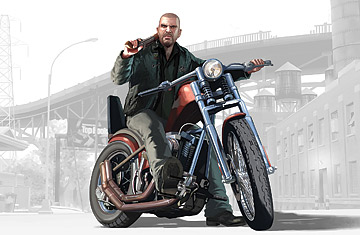
In the game's newest installment, Grand Theft Auto IV: The Lost and Damned, which will be released on Feb. 17, Houser and his team have ratcheted up the complexity even further. Instead of extending Niko's story laterally by adding a straight-up sequel, they're drilling down into it vertically: they picked a minor character from Liberty City, a biker named Johnny, and created a story around him that takes place simultaneously with Niko's, weaving across and over and through it.
At the start of the game, Johnny is acting as the leader of a biker gang called the Lost while the real boss, Billy, is in court-ordered rehab. When Billy gets out, a power struggle ensues. Johnny and Billy have different visions for the gang. Johnny is a tough guy, but he's got a cool head; Billy, who looks like Ron Perlman and talks like Dennis Hopper, is the wild man who wants to push the Lost deeper into drug-dealing and gang warfare. (See the best and worst Super Bowl commercials of 2009.)
There's a tragic edge to these men. The great days of the biker gang, if there ever were any, are behind us, and deep down, you sense that the Lost know it. That knowledge gives the men an air of faded grandeur that's borderline Faulknerian. In their lameness, their expired '70s-era cool, they're emblematic of an America in decline. "The whole thing was meant to feel almost like they're living on past glory," Houser says. "They think they're the last true Americans, the outlaws, the free." But like Niko — who appears periodically in Johnny's story and is an uncanny presence, since he's now outside the player's control — Johnny watches his fantasy deconstructed around him by main force. The further outside the law he goes, the more he sees that he's just as trapped as he ever was. "He's no freer than a guy who goes to an office every day," Houser says. "He's the same as a waiter. He thinks he's different, but he's not."
You can look at the whole GTA series as a sustained fictional inquiry into the myth of the great American badass — the criminal, the gangsta, the made man, the outlaw. It's a loving inquiry, but it has a consistent critical distance, an outsider's point of view. And no wonder: the games aren't created by Americans at all. Houser, a Brit, is based in New York City, but most of the work gets done by Rockstar North, a team of Scots based in Edinburgh.
Freedom isn't a problem for Houser. As a storyteller, he feels as though he's lucked into the lawless, Wild West period of video games. "It's not academicized," he says. "There's no orthodoxy on how things are done, so we can do whatever we want. We make it up as we go along!" As for the ongoing debate about whether games are art, he couldn't care less. That's what critics get paid for. "As soon as we get told, 'Yes, games are high art. They're almost as high as painting and slightly less than dance,' it's over. Freedom is dead at that point. Then the argument just becomes about people's egos. And my ego doesn't need to be told I'm an artist. I hate myself already!"
It's freedom that gives games their distinctive character as a storytelling form. They grant players the freedom to make choices rather than frog-marching them through the action. But therein arises a contradiction: in order to feel as if they're really interacting, players have to believe they can truly go anywhere and do anything in Liberty City. At the same time, in order for a story to get told, they must be gently but firmly stage-directed through the plot. "You've got this beautiful 3-D world that lives," Houser says, "and it's got all these background characters and its own Internet service and its own TV shows and all these other things that you can go and do and have wash over you. And you've got this story. It's about finding a balance between letting the player wander off and find stuff to do and then sucking them back in."
It's a quintessentially American conun-drum writ small: the right to liberty against the rule of law. Too many rules, and you feel like a puppet. Too few, and you're stuck wondering what you're doing there. "You want to avoid that basic fear of terrifying existential crisis," Houser says. "You don't want to put that into the game." There's enough of that in real life.