

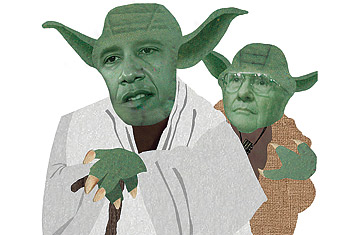
Eight years ago, at the brackish dawn of the second Bush era, TIME offered a list of potential national-security wise men. One was Brent Scowcroft. "Yoda of Dad's foreign policy team, will consult unseen in son's White House," we predicted, inaccurately. Instead, Scowcroft proved a demure scold. He opposed the Iraq invasion, publicly, in the Wall Street Journal. He scorned the neoconservatives and hard-power nationalists who controlled George W. Bush's foreign policy. In return, Scowcroft's brand of low-key "realism" was derided as milquetoasty by the neocons. The nickname stuck, however, among his associates at the Scowcroft Group: Yoda, he was. A fount of common sense, he remains. And so a not-so-bold prediction: "Yoda of Bush the Elder's foreign policy team will consult unseen in Barack Obama's White House."
Actually, Scowcroft already has consulted by phone with the President-elect. And Obama's national-security team easily could have been selected by Yoda himself. Secretary of Defense Robert Gates was Scowcroft's deputy in the first Bush White House. The incoming National Security Adviser, General James Jones, has been "close to" Scowcroft for years, according to an associate. Jones was Scowcroft's choice to lead the Atlantic Council, a redoubt of the foreign policy priesthood meant to encourage the American alliance with Europe (and therefore the very sort of institution disdained by the latter Bush's team). Gates, Jones and Scowcroft share not only a philosophy but also a style that suits the President-elect perfectly: they are "no drama" practitioners. (See TIME's Person of the Year, People Who Mattered and more.)
There were two signal moments during Scowcroft's tour as Bush the Elder's National Security Adviser that seem relevant to the job ahead for Obama. One was the patient construction of a vast international alliance to oppose Saddam Hussein's invasion of Kuwait — the alliance Bush the Younger was unable to construct when he invaded Iraq. The other moment, perhaps more significant in retrospect, occurred when Scowcroft and his boss agreed that it wouldn't be prudent for the President to go to Berlin to celebrate the fall of the wall in 1989. Didn't want them to feel "we were sticking our thumb in their eye," Bush the Elder allegedly said of the Russians, a strategy that proved essential to the quiet reunification of Germany, another Bush Administration success. (Yoda might have advised against Obama's splashy trip to Berlin last summer.) This sort of nuanced, civilized foreign policy was eschewed during the latter Bush's reign, an Oedipal idiocy. It is likely to return now. Nuance, negotiation, alliances, diplomacy — and the use of force only in concert with others or when U.S. interests are directly threatened — are back.
Scowcroft gave a typically succinct summation of his philosophy in a recent book, America and the World, which is a series of conversations between Yoda and Zbigniew Brzezinski, who was Jimmy Carter's National Security Adviser, presided over by David Ignatius of the Washington Post. "The United States ought to be on the side of trying to achieve maybe a little more than it can. But not too much," Scowcroft says. "When we say we are going to make the world democratic, that's too much. And in the attempt, as we are seeing right now, we risk creating more harm than good."