

(2 of 2)
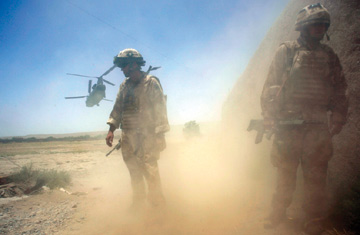
Many in Europe know just what to do with this peace and prosperity: lie back and enjoy it. As Gideon Rachman argued in a provocative column in the Financial Times in May, Europe has become a "giant Switzerland." Its people do not consider themselves threatened by the turmoil in the world around it, and see little point in going out looking for dragons to slay. Barack Obama may be Europe's darling, but he will find that his suitor's ardor cools pretty quickly the moment he asks European parents to volunteer their sons and daughters to beef up NATO forces in Afghanistan.
This unwillingness to engage with the rest of the world — to risk the sense of security that it enjoys within its own borders — led Kishore Mahbubani, dean of the Lee Kuan Yew School of Public Policy at the National University of Singapore, to reply to Rachman's column by saying that Europe was a "political dwarf in ... the rapidly changing geopolitical environment." There's an element of truth to the charge, but it goes too far. For one thing, it ignores the triumphant role of exemplar that the European Union has played in the last two decades. Yes, the pettifogging rules and endless bureaucratic wrangling of the E.U. may be easy to satirize — and when asked in referendums, Europeans repeatedly indicate that they do not want the E.U. to turn into a giant superstate. But it was the promise of accession to the E.U., with all its economic benefits, that did more than anything else to extend a zone of peace and prosperity from the borders of the old West Germany further east.
Nor have today's European leaders been entirely supine in the face of Mabubhani's "rapidly changing geopolitical environment." The British leaders Gordon Brown and Tony Blair have a long record of arguing for assistance for the poorest parts of the globe. The initiative this year of French President Nicolas Sarkozy to start building a true community on both sides of the Mediterranean, grandiose though it sounds, is important. It recognizes a fundamental truth; that the futures of the aging populations of rich Europe and the young ones of the poor Maghreb are inextricably linked, and that institutions need to be built to ensure that those futures are happy ones. And when one turns to nonstate actors, European engagement in the world is striking. From ngos like Médecins Sans Frontières and Greenpeace, to the actions of two scruffy (but very, very rich) Irish rock stars, Europeans have been in the forefront of the movement to put a human face on globalization. (Read world leaders' view of Obama's win.)
Still, more needs to be done. Europe is not an island, and even judged by the narrowest tests of self-interest, it has an abiding need to ensure that its neighbors can savor the same peace and prosperity that Europeans now enjoy. From that logic of geography should flow two pressing priorities of European strategic policy: closer engagement with Russia and with Turkey. Both nations feel aggrieved at their treatment by Europe, Russia because (in breach of promises made in the early 1990s) NATO was extended not just to the borders of the old Soviet Union but actually inside them; Turkey because it thinks that the E.U. intends to dangle the carrot of accession, while never truly intending Turkey to nibble on it.
Europe's Challenges
In the wake of the Georgian weekend war this summer, and amid the usual bellicose speechifying by Russian leaders, finding common ground between Russia and Europe will not be easy. But it is important to make a start, because the risk of alienating Moscow is a real and dangerous one. And as Joe Joffe argues in the accompanying essay, when talking to Russia, Europe is stronger than its behavior would often suggest.
In the case of Turkey, the question for Europe is not, as with Russia, how to avoid a dangerous rivalry. It is, rather, how to institutionalize relations with Turkey so that it can be Europe's partner in a dangerous neighborhood. At a recent World Economic Forum conference in Istanbul, I was struck both by how creative Turkish diplomacy now is in the whole ring of instability to its east and south, from Armenia right round to Syria, and how much Turks wanted to work with Europeans to extend the area of peace and economic integration which has, since the Treaty of Rome 51 years ago, steadily moved from the North Sea eastwards.
It will take skillful diplomacy and sustained political and economic engagement for Europe to find new and better relations with Russia and Turkey. And here is the key thing: the U.S., however charismatic its new President may be, will be little or no help. Russia and Turkey are Europe's neighbors, not America's. Washington will always see relations with its former superpower rival differently from the way Europe does — as, indeed, was demonstrated in its reaction to the Georgian war.
And that, perhaps, is the best of all reasons why Europe needs to get over its crush on Obama. In the things that really matter to Europe, it doesn't help. Love is a fine thing; but as all who have loved know, it does not solve all the problems that life throws our way.