

(3 of 5)
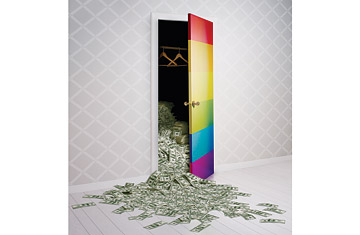
And yet the Cabinet is noteworthy not only because its treasure begets political influence but also because its very existence shows how dramatically the culture wars--and liberal politics as a whole--have changed in the past decade. Next summer gays will celebrate the 40th anniversary of the Stonewall riots, the 1969 Manhattan demonstrations that began when cross-dressers angry about police raids at the Stonewall bar began throwing bottles and punches. Today, though, the street movement is basically defunct. And increasingly, the center of gay power is moving out from Washington toward the interior--toward powerful foundations like those run by Stryker in Kalamazoo and Gill in Denver. Since the beginning of 2001, Stryker's foundation, which is called Arcus and has offices in both the U.S. and the U.K., has given away $67 million, about three-quarters to gays and about one-quarter to apes. (Stryker, who got a pet monkey as a gift when he was young, is a major donor to the conservation of ape habitats.)
The Cabinet is emblematic of a larger shift on the left since 2004 in the direction of big-money politics, a shift most clearly seen in Barack Obama's refusal of public financing for his campaign. The Cabinet is only one of several flush, members-only liberal groups that have formed since 2004, the most famous (and richest) being the Democracy Alliance, whose sponsors include billionaires George Soros, Peter Lewis (father of Cabinet member Jonathan) and Pat Stryker (sister of Cabinet member Jon).
That raises questions: What does a civil rights movement look like in an era of massive wealth? Can you still inspire a grass-roots movement when all the street troops know that the billionaires can just write bigger checks? And is it possible that the left has become a movement as coldly obsessed with money as it always assumed the right was?
Gays may see the cabinet as powerful, almost numinous, but its own members see themselves as largely unorganized and highly independent. "It's a group of people who like and respect each other and their opinions," Ray Mulliner, a longtime Hormel adviser, told me recently. "It's nothing more than like-minded donors getting together to share strategies." When I mentioned that similar organizations on the right had received press scrutiny--I was thinking of the Arlington Group, a coalition of movement conservatives--Mulliner angrily rejected the comparison: "You have no reason to be curious about this. You're going to write a piece that's going to start a fire that needs to get put out, and it's going to cost a lot of money to put it out," he said.
The Cabinet first came together three or four years ago, according to Van Ameringen, as a "meeting place" for donors who wanted to use their money with greater strategic acumen. Gill got the idea for the group after he and Lewis attended a Democracy Alliance meeting. The donors felt they could accomplish more for gays if they shared information rather than operate as "silo" givers. Some members were frustrated that the established gay movement in Washington hadn't made greater progress in a society rapidly coming to see homosexuality as a mere variation rather than a moral degeneration.